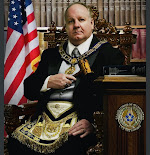
At the May Communication 1864, Grand Master Coates recommended that preliminary steps be taken looking to the inauguration of the enterprise. It was resolved to issue stock to the extent of $200,000 and that as soon as the subscriptions thereto amounted to $50,000, the Grand Charity Fund should be invested in the same security. A Building Committee was appointed consisting of [Grand Master] John Coates, Francis Burns, John S. Berry, Charles Webb, William Wilson, Jr., George J. Kennard, and James Logue. Bro. Edmund G. Lind was subsequently selected as Architect.
In November 1865, the Committee reported the purchase of the site of the present Temple on North Charles Street, and in May following, additional ground was bought to enlarge the lot. On the 20th November, 1866, the Grand Lodge laid the cornerstone of the New Temple with imposing ceremonies. The procession was immense, including Lodges, Chapters, and Commanderies at home and from various other States. The President of the United States, Bro. Andrew Johnson, Past Grand Master of Tennessee, with his Secretary, Bro. Robert Johnson, escorted by Governor Swann and his uniformed Staff, joined the procession at the Governor's residence on Franklin Street and marched with the Grand Master his suite through the open lines to the site of the new Building.
Hymns composed for the occasion by Rev. Andrew Longacre and Hon. Brantz Mayer were sung by a choir of two hundred voices, accompanied by an orchestra, under the supervision of Bro. Robert J. Kerr. Rev. R.W. McMurdy of New York, Grand Prelate of the Grand Encampment of the United States, acted as Grand Chaplain.
Our distinguished and now venerable Brother, John H.B. Latrobe, delivered an able and eloquent oration, concluding with the following beautiful peroration: “Whether Freemasonry may go back to the Mithratic caves, Egyptian or Grecian temples, to Roman Collegia, to the House of the Lord at Jerusalem in Moriah—to the preceptories of the Templars—to the Crusades—to the charter of Athelstan—or the Lodge of Kilwinning—is, after all, but of little moment. Its principles can alone be relied on to maintain our time honored Order in its purity. They inculcate charity to all mankind—a charity without stint—a brotherhood without boundaries—religion without sectarianism— patriotism without party—a union, not of hands only, but of hearts—a union not limited to persons, but embracing states and nations and all this accompanied by the profoundest recognition of man’s dependence upon Him, whose All Seeing Eye is our emblem, who hath measured the waters in the hollow of his hand, and meted out the Earth with a span, and comprehended the dust of the Earth in a balance and weighed the mountains in scales and the hills in a balance….”
The building of the new Temple had meanwhile progressed amid rejoicing and congratulation and at the May Communication 1869, Grand Master Coates, Chairman of the Building Committee, reported that the Temple was completed and ready for occupancy. But now came “the tug of war.” It had not been paid for...
All efforts were now directed towards raising the means to meet the pressing claims. Taxation upon the Subordinate Lodges was necessarily resorted to, and in the emergency a host of critics arose to find fault with the plan of building and even the policy of erecting the structure at all. Unfortunately the main hall, which had been relied upon as a source of large revenue from rentals, proved deficient in its most important requirement: acoustics.
Murmurings of discontent, complaints, and even denunciations, became the order of the day, and many brethren who could doubtless have built a different Temple, felt and expressed confidence that they could have built a better one. Meanwhile the creditors, not content with urging the payment of their claims by pacific methods, had resorted to legal process and the sale of the Temple to satisfy its liens was only delayed by the struggle for priority among the various claimants. It happened at this critical juncture in the affairs of the Grand Lodge, as it always does in meritorious cases in human affairs, that men were found to meet the emergency. At the November Communication 1780, Brother John H.B. Latrobe, who had delivered the Oration at the laying of the cornerstone of the building, was elected Grand Master and at once called a halt in the rapid march towards financial disgrace.


 Posts
Posts