



The Magpie Mason is an obscure journalist in the Craft who writes, with occasional flashes of superficial cleverness, about Freemasonry’s current events and history; literature and art; philosophy and pipe smoking. He is a Past Master of both The American Lodge of Research in New York City and of New Jersey Lodge of Masonic Research and Education 1786; and also is at labor in Virginia’s Civil War Lodge of Research 1865. He is a past president of the lamented Masonic Society as well.
Yesterday, at New Jersey Lodge of Masonic Research and Education 1786, W. Bro. Gerald, of Congdon-Overlook Lodge 163, presents his findings on the history of a Pennsylvania lodge chartered in Colonial times at Basking Ridge, New Jersey.
I enjoyed one of those four busy weekends per year I get when there are three meetings squeezed into a 24-hour period: Scott Council on Friday night, New Jersey’s research lodge the following morning, then my AMD council last night. It’s a lot of driving, but it’s been a routine for decades at this point, so I feel obligated.
Scott Council 1, of Royal and Select Masters, meets every other month at Freemasons Hall, home of Union Lodge 19, in North Brunswick, New Jersey. Almost always a good time, and we benefitted from Light from the East, thanks to T.I.M. Michael. He presented a talk on Jephthah from the Book of Judges—his life and times, as well as his importance in Masonic theory and ritual.
In the morning, I was back in the same lodge room for New Jersey Lodge of Masonic Research and Education 1786. (Maybe I should just stay the night in a local hotel.) If you want to celebrate America250 in New Jersey Freemasonry, the research lodge is the place to be!
Senior Deacon Glenn examined the treason of Gen. Benedict Arnold vis-à-vis the morality of our gentle Craft’s teachings, leading to a philosophical discussion of what does it mean to be a rebel disloyal to the rebellion. W. Bro. Gerald of Congdon-Overlook
163 (not a member of our research lodge—yet), presented “Basking Ridge #10: The Mysterious and First Masonic Lodge of the
Jurisdiction of the Grand Lodge of New Jersey.” This history of the origins and life of the lodge, which was located in Gerry’s town, illustrated how central it was to the New Jersey Masonic story.
Magpie file photo
This artifact is found inside the Museum of Masonic Culture at the Trenton Temple.
We segued from Solomon’s Lodge 1 to Haym Solomon to conclude the program portion of our meeting with a screening of the Oscar-winning Warner Bros. short film from 1939 Sons of Liberty. Starring Claude Rains, this was made by the director who would go on to direct Casablanca. The 20-minute biography of Haym Solomon told the story of how part of the Revolution came to be financed.
Charmingly corny, it also inadvertently gives us a look at how patriotism was expressed in an America that still was pro-America. The past is a foreign country, indeed.
Secretary Erich shared the progress being made in the publication of our first book of transactions in a dozen years.
Click to enlarge.
We talked about the Skene Conference coming in August. Buy your tickets already! The line-up of speakers is amazing, and you’re going to miss it? Are you serious?
We ended somberly, noting the death last Sunday of Gordon S. Wood. The Pulitzer-winning historian was an authority on the American Founding. Not a Mason (as far as I know), but he wrote of the Masonic Order of that era, describing its essentiality as a social network that united elites and nobodies in workshops of democracy, learning self-governance through practical local actions. Age 92. Hit by a car. Terrible.
And we were out by noon. A hearty lunch at a nearby restaurant ensued, but attendance was scant due to a variety of other events in the general area, from a ribs cookout to the Rosicrucian College’s convocation to a Third Degree.
I then headed to Hightstown for the quarterly meeting of J. William Gronning Council 83 of Allied Masonic Degrees. It was afternoon still, so I sat in the shade for a time and read the new Collectanea. In the meeting, I milked my Thomas Reid paper yet again, which seemed to have been well received. Reid was the Scottish Enlightenment philosopher whose words are heard in lodges today in our Middle Chamber Lecture. Sovereign Master Robert presented an overview of our actual allied Masonic degrees, explaining why AMD exists and where its role fits in the overall Masonic fraternity as a nexus of philosophy, scholarship, and research.
Looking to our September meeting, a degree will be conferred, which is always a good thing. Read all about it this summer in the Gronning Gazette.
Seriously, a lot of driving. It’s a good thing I like being a Freemason.
I’ll try to catch up recapping recent events. Maybe work my way backward, starting with a visit to Nutley Lodge 25 in New Jersey last Monday.
It was my first time back since 2016, so I wasn’t surprised to meet mostly new faces, but being with Bill, Joe, George, Ed, Rowland, et al. seemed like old times. I was invited over to present a talk from the lectern, so I delivered my explanation of how a Scottish philosopher’s eighteenth century findings on man’s five physical senses came to be included in our Middle Chamber Lecture.
In “It’s Just Common Sense: Thomas Reid and the Fellow Craft Degree,” I share what is known of the Second Degree before the influence of William Preston is felt; then we see Preston in his print shop, where he very well might have worked on Reid’s An Inquiry into the Human Mind; and then we hear Preston’s paragraphs on physical senses. The talk is almost half over by the time I get to Reid’s treatise, zeroing in on his second chapter, titled “Smelling.” (It would require too much time to sample Reid’s thoughts on all the senses.) In short, Dr. Reid, who founded The School of Common Sense, authored the words on the five senses in the 1760s that Preston <cough>borrowed for his book Illustrations of Masonry in the 1770s, which is the basis of so much of what we say in lodge to this day. When connecting those dots, I had to cite New York’s version of the Middle Chamber Lecture also because more of Reid’s words are evident there than in New Jersey’s, which only briefly has some of that source material. I hope it all left a palatable taste in the brethren’s mouths.
In fact, the Q&A mostly was about the differences in New York and New Jersey rituals. The audience was surprised to hear about the intricacies of our New York material. We have a bigger Middle Chamber production. Without even getting into our optional long form, New York lodges’ Second Degree lecture has organ music and singing—and I swear I once saw some soft shoe on the Winding Staircase! (Although that may have been a dream. Robert Morse was there.) Before wrapping up, we chatted about Garibaldi Lodge’s exotic EA°, which left an impression on those brothers who experienced it.
My thanks to Worshipful Master Nicholas Luciano for allowing me to do this. It’s always a great time at Nutley. I hope they bring me back one night. If you’ll be in the neighborhood, Monday the 18th will be the occasion of the Official Visit of the District Deputy Grand Master.
It’s official: The Magpie Mason will return to Nutley Lodge 25 in New Jersey for a speaking engagement—first time in ten years, as a matter of fact. I guess that’s how long it takes for everyone to forget the reasons not to invite me over and speak.
On Monday, May 4, I will be dining out yet again on my talk: “It’s Just Common Sense: Thomas Reid and the Fellow Craft Degree.” This is an explanation of how a very influential Scottish Enlightenment treatise came to provide part of the Middle Chamber Lecture, with context on what the Second Degree looked like before this lecture was devised, and other admissible evidence.
Lodge tyles at 7:30. 175 Chestnut Street in Nutley, really only a short ride outside of Manhattan.
My own lodge’s meetings coincide with Nutley’s, but not on this date due to the Grand Lodge of New York’s Annual Communication that day.
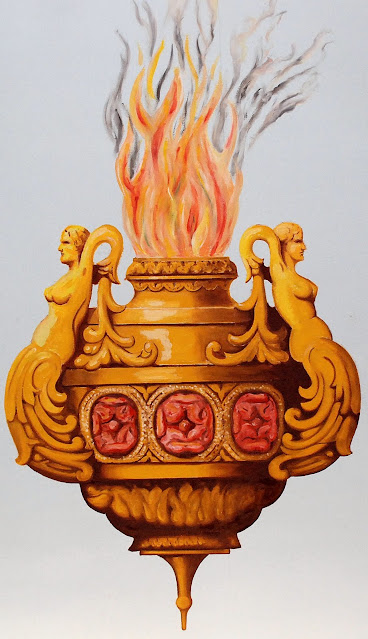
For the second time in two weeks, the Master of my lodge called on me to lead an educational discussion for the brethren. This is a very singular occurrence! Publicity Lodge actually didn’t hold an in-person meeting last night, opting instead for a Zoom gathering as New York City adjusts to the latest virus variant. (Only a few of us seem to understand how these variants will vary in perpetuity, so we might as well resume normalcy, but that’s another story.) Because my talk on mindfulness exercise last month on St. John’s Day went over okay, I thought I should double down and dust off my old presentation on the Pot of Incense as a Masonic symbol.
Actually, this was an abbreviated version of the original, at about half the length, that I had to read because it had been so many years since I last presented it. Rather than summarize it for you here, I hoped to link to some previous edition of The Magpie Mason that spells it all out, but I guess I never wrote that blog post. All I got is this from ten years ago. But “The Emblem of a Pure Heart” gives a history of incense’s ritual usages, several verses from the Hebrew Bible, bits of arcane Masonic rituals, quotations from natural philosophers of centuries past, and some suggestions for how to incorporate the burning of incense in our lodge meetings today—and that’s when things got interesting.
The brethren love the idea of adding a gentle amount of frankincense aroma at the Inner Door, when the candidate enters the worshipful lodge, and again at the altar upon being obligated. I made the case for the sense of smelling, in addition to being explained in the lecture of the Second Degree, also is a catalyst for recollecting vivid memories. One of the brethren listening said there are scientific data linking olfactory stimuli to the eliciting of old memories. So I’m envisioning our use of incense will plant meaningful impressions in our initiates that will re-emerge every time that familiar scent appears, and that all the brethren will share the experience.
While I was speaking, the Brother Secretary went online and procured a gizmo that vaporizes frankincense oil, so we’ll be able to enjoy the aroma, but without generating any smoke. (One of our most venerable Past Masters explained that it is possible to have our smoke detectors switched off temporarily, but it’s a complicated arrangement requiring the building management’s attention. The vaporizer will more than suffice.) My personal preference would be to load my censer with smoldering charcoal and roasting resins to fill the space with glorious plumes of aromatic smoke—but I can’t because I don’t own the place.
While preparing for last night’s discussion, I hacked away at the text to make it somewhat brief, and I deleted information I ought to have kept, and I kept stuff I could have done without. I omitted Thomas Reid(!) on the sense of smell, but retained Rene Descartes, when I should have done the reverse. Small matter. What’s more important is Publicity Lodge will initiate four petitioners on February 7 with an enhanced ambiance that further emphasizes the crossing into a new community, a new consciousness.
Maybe one future night, after I’m long gone, one of these Apprentices (perhaps a Past Grand Master by then) will attend a degree at Publicity, and will be returned to that first Monday of February 2022 thanks to a familiar scent—coming from some AI app downloaded into his olfactory cortex.
My thanks to Worshipful Master Diego and to all the brethren. I feel like I finally accomplished something in Freemasonry.