


 Posts
Posts











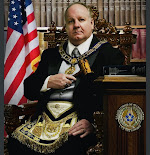












Oklahoma Masonic Indian Degree Team’s gavel.
Masonry endeavors to instruct men about the elements of life that are worthwhile and have lasting value; to teach of the relationship in which men should stand, one to another; and to impart the lesson that he who gives the best and richest in himself to those around him, receives the very same in return, with added measure. A Masonic Lodge is a gathering of men who believe in Creator and society; men who uphold the principles and ideals revealed in the Volumes of Sacred Law; and men who promote the universal ideals of liberty, equality, and freedom.

Installation of OfficersGrand Lodge of New York
 |
| Great flying weather, but four flights in thirty-three hours was a workout for me. (I find American is better than United.) |
Cripes, now I know how Craddock feels!
The Magpie Mason recently undertook a speedy tour of the Midwest, flying to and from Tulsa, Oklahoma by way of four airports in about thirty-three hours. I’m an infrequent flyer, so this was a workout for me, but it was totally worth it, having been able to attend the Joint Traditional Observance Lodge Festive Board on St. John’s Day. This, the third annual event, is sponsored by the four Traditional Observance lodges in Oklahoma: Guildhall Lodge 553, Veritas 556, Vitruvian 557, and Providence 558.
 |
| At Oaks Country Club in Tulsa. |
Our host on St. John’s Day was Vitruvian, whose Worshipful Master, David Dill, contacted me last year to ask if I might be available to serve as speaker at a not-yet-defined event in 2026. I shouted Yes!, with uncharacteristic enthusiasm. I figured I’d be forgotten or replaced with a better choice before too much time passed, but there I was at Oaks Country Club, after some time assessing the qualities of several area craft beers with David and others at McNellie’s South. (I wouldn’t say day drinking makes me a better speaker, but it lets me not mind it so much.)
 |
| Brethren donated top shelf stuff for auction. |
It was a great night. Festive is the operative word in Festive Board, and the great food, quaffable beer, wine for toasts, and camaraderie ensured a convivial evening. Our ritual had been sourced from a few places, including London, where David once visited twelve lodges in two weeks(!), with each hosting a Festive Board. And there was singing. The usual tunes, plus “Viva la Compagnie!” We had the room only a few hours, so brevity was key; I kept my remarks at the lectern to about twenty minutes. Titled “The Elements of Life,” this new talk extolled the value of tradition in Freemasonry. That could cover many areas, but I zeroed in on certain things we think, say, and do in our lodges.
That excerpt at top, from our New York Installation of Officers, talks specifically about our relationships to each other and to God as upholders of a free society. I thought it apt, as Independence Day neared. That gavel belongs to the Oklahoma Masonic Indian Degree Team, which was well represented that night by W. Dill and others.
(If you are wondering about the T.O. term, that’s how they like it in Oklahoma. In New York, we designate such lodges as O.M., for Observant Masonry, echoing the Masonic Restoration Foundation. For me, the terminology is less important than the best practices, as culled from our rituals, orations, jurisprudence, etc., that should guide lodges.)
I got to shake hands with MW Robert G. Davis for the first time in a long while. Bob spoke first, rendering a spiritual introduction to St. John Baptist Day in relation to our place in the cosmos via the summer solstice. I didn’t know he was to precede me, and I felt terrible having to contradict him when it was my turn to speak.
I broached the topic of tradition by explaining how sometimes they get started in ways we today do not remember. I relayed Pete Normand’s explanation of how June 24 became an occasion of Masonic feasting. (Pete, I hope you don’t mind, but I urged the Master of next year’s host lodge to book you as speaker for this event.) In short, June 24 was one of four Quarter Days, holidays throughout the year when everyone was off from work. However, the saint we read about in the Old Charges is St. Alban, who looked after masons in England during the third century. Meanwhile, neither Saint John is found anywhere in that vast body of literature penned between the fourteenth and eighteenth centuries. Alban’s feast day is June 22, not the day off from work everyone got in 1717, so he was supplanted with St. John the Baptist for convenience.
If that thinking lacks gravitas to you, as today is Independence Day, for another hour, in the United States, I’ll point out another two-day discrepancy: July 2 was the date in 1776 when the Second Continental Congress voted to declare “That these United Colonies are, and of right ought to be, free and independent States, that they are absolved from all allegiance to the British Crown, and that all political connection between them and the State of Great Britain is, and ought to be, totally dissolved.” July 2 was the date John Adams predicted “will be celebrated, by succeeding Generations, as the great anniversary Festival… It ought to be solemnized with Pomp and Parade with shews, Games, Sports, Guns, Bells, Bonfires and Illuminations from one End of this continent to the other from this Time forward forever more.” Yet, here we are every Fourth of July.
I have found how, when we study history enough, we realize inevitabilities, like truth can be stranger than fiction. Other times, coincidences become visible in hindsight, and that sometimes “you can’t make this stuff up.” And, especially, there are instances when the simple explanation works best.
In contrast, here are Faceypage posts in reply to someone’s innocuous St. John’s Day message:
 |
| Wut. |
Not everybody plummets down this kind of rabbit hole, but, when a less-than-obvious explanation of something simple takes root, some will explore tangents that lead even further from tradition. Thanks to Pete, I think Masonry’s standard accepted Holy Saints John-parallel lines-solstices theory represents an accretion of ideas that doesn’t withstand scrutiny. It never made sense to me, but it became our tradition.
But my main point in Tulsa was to note a few traditions in what we think, say, and do in our lodges.
For this, I covered territory familiar to regular readers of this website. I think understanding this material is very important—they are “elements of life”—namely:
‣ The centrality to Freemasonry of belief in God, as presented in Charge I of Anderson’s Constitutions, which lives on today in many grand lodges’ law books; in the meaning of our term Great Architect of the Universe, borrowed from John Calvin; and in Anderson’s history of the fraternity, beginning with Adam, “who taught his sons Geometry.”
‣ How Masons of diverse religious opinions coexist by “leaving their particular opinions to themselves” and allowing Masonry to be “the center of union.”
‣ How a Mason is peaceful “to the civil powers, wherever he resides and works,” upholding a tradition dating to the time of Henry VI.
‣ How we, as Masons, subdue our passions and improve ourselves, in a tradition that takes us back to Plato.
‣ And more.
I rarely feel positively about my speaking engagements, but this one went well. I was alarmed by the lack of Q&A (always a bad sign), but a number of the brethren took me aside near the end of the night to thank me for specific points in the talk. I’ll take it.
I even met a brother from Independent Royal Arch 2. I spotted his lodge necktie, and we chatted about New York and Masonic Week.
 |
| Vivat! Vivat! Vivat! |
In souvenirs, I made out like a bandit, scoring not only the evening’s official beer glass and English-made firing glass, but also one brother’s gift to me of his personal Guildhall 553 firing glass, plus an Oklahoma Masonic Indian Degree Team coin. And I managed to get all that fragile glass home intact.
 |
| Obverse of Oklahoma Masonic Indian Degree Team’s coin. The state is rendered in red because ‘Oklahoma’ derives from the Choctaw language, meaning ‘red people’ or ‘red nation.’ |
I wished I could have stuck around longer, maybe just another day to visit the Woody Guthrie and Bob Dylan museums, see some of Route 66, and try the smoked bologna (talk about elements of life!) at Big Daddy’s. I’ll have to get back some time.

I lack the talent to join that top tier of Masonic thinkers who regularly travel the country on the lecture circuit, but it is flattering to be invited and receive the red carpet treatment. My next turn at the lectern will be “across the river to the Jersey side” to discuss the Anti-Masonic Party in New Jersey at the research lodge on September 12, the 200th anniversary of the alleged disappearance of William Morgan. No singing and drinking there, I’m told.


No comments:
Post a Comment