

Showing posts with label Massachusetts. Show all posts

Friday, April 3, 2026

‘Let the benign Genius of the Mystic Art preside’

    
Monitor of the Work, Lectures and Ceremonies of Ancient Craft Masonry in the Jurisdiction of the Grand Lodge of Free and Accepted Masons of the State of New York is available from Lodge Services or your lodge secretary. (Okay, maybe a graphic designer might have helped a little with the cover but, hey, it’s done.)

Many years in the making, Grand Lodge’s Monitor is published and is available from Lodge Services. Its proper title, Monitor of the Work, Lectures and Ceremonies of Ancient Craft Masonry in the Jurisdiction of the Grand Lodge of Free and Accepted Masons of the State of New York, the book is copyrighted 2025, but I learned of its existence—again, after anticipation of years—just a week ago through a comment on Faceypage. Got my copy yesterday.

Immediately, I searched for content unknown to me, and no sooner than on Page 7 are Opening Charges.

Opening Charges?

Opening Charges!

You probably know a Closing Charge, delivered at, yes, the close of the lodge communication. I doubt it is ubiquitous throughout the country, but it is found near and far. In New York, we call it the Harris Charge (“…you are now about to quit this sacred retreat of friendship and virtue…”). It is an optional coda to the meeting, although I don’t know why a Master would opt out of it. When it was my privilege to serve in the East twenty-one years ago in New Jersey, that was possibly my favorite piece of Work. It differs slightly from New York’s version.

Who’s Harris?

Bro. Thaddeus Harris
The Rev. Thaddeus Mason Harris, D.D. (1768-1842) was a Massachusetts Freemason. More than that, he was that Grand Lodge’s first Grand Chaplain. (Synchronously enough, he laid down his working tools on this very date, April 3.) He also served as Corresponding Grand Secretary and, in 1812, was appointed Deputy Grand Master! A remarkable seminal figure in Massachusetts Freemasonry, but he is a topic for another edition of The Magpie Mason. (This portrait of Harris hangs, if I remember right, on the ground floor of the Boston Masonic Building, home of the Grand Lodge of Masons in Massachusetts.)

Where was I going with this? Yes! These Opening Charges.

They are not new to Freemasonry, but they’re news to me and they are terrific brief orations you’ll be proud to hear at the start of your lodge meetings. There are two, prefaced with this:


Performance of an Opening Charge is optional. One charge or the other, without alteration or combination, may be given in full immediately following the prayer in the Ritual of Opening, or at the commencement of any untiled Masonic event. Only The Monitor or The Chaplain’s Book are to be used if the charge is read in a tiled lodge.


The first Charge:


The ways of science are beautiful. Knowledge is attained by degrees. Wisdom dwells with contemplation. There are we to seek her. Though the passage be difficult, the farther we proceed, the easier it will become. If we are united, our society must flourish. Let all things give place to peace and good fellowship. Uniting in the grand design, let us be happy in ourselves, and endeavor to contribute to the happiness of others. Let us promote the useful arts; and by them mark our superiority and distinction. Let us cultivate the moral virtues; and improve in all that is good and amiable. Let the genius of Masonry preside over our conduct; and under its sovereign sway let us act with becoming dignity. Let our recreations be innocent, and pursued with moderation. Never let us expose our character to derision. Thus shall we act in conformity to our precepts, and support the name we have always borne, of being a respectable, a regular, and a uniform society.


The second Charge:


The ways of Virtue are beautiful. Knowledge is attained by degrees. Wisdom dwells in contemplation: there we must seek her. Let us then, Brethren, apply ourselves with becoming zeal to the practice of the excellent principles inculcated by our Order. Let us ever remember that the great objects of our association are the restraint of improper desires and passions, the cultivation of an active benevolence, and the promotion of a correct knowledge of the duties we owe to God, to our neighbor, and to ourselves. Let us be united and practice with assiduity the sacred tenets of our order. Let all private animosities, of any unhappily exist, give place to affection and brotherly love. It is useless parade to talk of the subjection of irregular passions within the walls of the Lodge, if we permit them to triumph in our daily intercourse with each other. Uniting in the grand design, let us be happy ourselves, and endeavor to promote the happiness of others. Let us cultivate the great moral virtues which are laid down on our Masonic Trestleboard, and improve in everything that is good, amiable and useful. Let the benign Genius of the Mystic Art preside over our councils, and under her sway let us act with a dignity becoming the high moral character of our venerable institution.


So, if these stirring words did not flow from RW Harris’ heart and mind, whence came they? I thought some of the phrases sounded familiar, but wasn’t sure if my memory was tricking me, so I asked Sam.

RW Samuel Kinsey, of Mariners 67, is Chairman of the Custodians of the Work, the team that preserves Grand Lodge’s Standard Work and Lectures and that publishes these books we need to learn our rituals and orations. He provided me a snippet of the Custodians’ report to Grand Lodge, which will meet next month:


The antecedents of the Opening Charges may be found in A Vindication of Masonry and its Excellency demonstrated in a Discourse at the Consecration of the Lodge of Vernon Kilwinning, on May 15, 1741 by Charles Leslie. This lengthy discourse was later incorporated into the first edition of William Preston’s Illustrations of Masonry, with increasingly revised and reorganized forms of the Vindication continuing to feature in all subsequent editions. In the early decades of the nineteenth century Thaddeus Mason Harris adapted one of Preston’s later versions into the first Opening Charge given above (the shorter of the two). The second Opening Charge originates in Charles Whitlock Moore’s The Masonic Trestle-board, which purported to contain the working from the Baltimore Convention of 1843. This is the Opening Charge that can be found in Monitors with relevancy to our jurisdiction throughout the remainder of the nineteenth century. Although the two Opening Charges reference the same source material and evoke a similar sentiment, your committee believes both are beautiful expressions that deserve to be authorized for use.


There’s a lot more marrow in the bone of this edition of The Monitor, the first published since 1989. The Installation of Officers is revised, just in time for our Installation nights. Now I have to see what The Chaplain’s Book is. Never heard of it.

From the 1740s to the 1840s to the second quarter of the twenty-first century, what we, as Free and Accepted Masons, think, say, and do in lodge remains continuous and relevant, no doubt thanks to our own consistency when we “mix again with the world.”

If you are of these households of the faithful, I wish you a Happy Passover or Happy Easter.
     

Thursday, September 19, 2024

‘The Massachusetts Masonic U.S. half dollar’


It sounds too good to be true: United States legal tender coinage with a distinct Masonic provenance—but apparently there were half dollars struck in 1864 that tell an unusual story about a lodge in Massachusetts.

In June, Stack’s Bowers Galleries auctioned one of these scarce pieces. Writing the June 19 “United States Coin of the Week” column, Chris Bullfinch reports:


On April 5, 1864, a fire destroyed the Boston Masonic Lodge known as Winthrop House, causing significant loss, including a number of silver ceremonial implements. The silver from these implements was recovered in the days after the fire and sent to the Philadelphia Mint to be coined into half dollars, which were in turn sold for $1 each to raise funds for the temple’s reconstruction. Each of the handful of known pieces is engraved to an individual person. This coin was engraved to William Bogle, a Brother at the Masonic Temple that provided the silver.

He emigrated to the United States from Scotland in 1840, settling in Boston, later North Malden, and establishing a hairdressing and wig making business on Washington Street in downtown Boston. He made his fortune selling hair care products of different kinds. He joined the Freemasons at the Lodge of St. Andrew in Boston in 1849 and was a charter member of the Wyoming Lodge, which was established in Melrose, Massachusetts in 1856.

At the time we last auctioned an 1864 Boston Masonic Lodge half dollar, in spring 2022, roughly eight were known. Some experts on Masonic history think there are likely more, but at time of writing, nine are known (including this example). Expert consensus holds that the engraving was done outside of the Mint, likely by a silversmith or jeweler in the city.

Bogle was a member of other Boston fraternal organizations, including the Scots Charitable Society and the Ancient and Honorable Artillery Company of Massachusetts. Some historical sources credit him with suggesting the name of Melrose, Massachusetts (formerly North Malden). He died in 1891. The Boston Post ran an obituary that described him as “godfather of Melrose” and offered this: “In his early years he took quite a lively interest in local affairs of the town and was prominent in its town meetings but always declined any public office.”

The consignor reports that they received this coin in change at a fast food restaurant decades ago. Owing to its unusual design, they kept it and presented it to a numismatist last year.


Our cataloger’s assessment of the Masonic half dollar’s appearance: “Beautifully and naturally retoned surfaces are dressed in warm dove and pewter gray shades. Hand-engraved with great skill in the left obverse field to WM. BOGLE, and with BOSTON / ENCAMPMENT in the right field. The reverse is similarly engraved around the central device, TAKEN FROM THE RUINS OF MASONIC TEMPLE / APRIL 6, 1864.”


I cannot find anything on the auction, whether this lot was sold, and at what price.

In related news, W. Bro. Stanley Chu, of Dalhousie Lodge in Massachusetts and an employee of Stack’s Bowers, made the news on WBZ with his appraisal of an extremely rare three pence coin minted in Boston during the 1650s:


Thursday, May 23, 2024

‘Masonic Con returns to Ezekiel Bates Lodge’


Believe me, you’ll hear about Masonic Con New York, next January, when the time comes, but this edition of The Magpie Mason concerns the originators of Masonic Con announcing their next event for the first weekend of October at Ezekiel Bates Lodge in Attleboro, Massachusetts. From the publicity:


The original Masonic Con returns with an exciting lineup! Join us for a weekend filled with forty unique vendors, six engaging speakers, and an unforgettable festive board.


The event kicks off Friday night with Ezekiel Bates Lodge’s 154th installation of officers, setting the stage for a remarkable experience. Saturday: an entire day of amazing guest speakers and masonic venders from across the country! On Sunday, immerse yourself in a historical tour of Providence, exploring Masonic landmarks, Revolutionary history, and the world of H.P. Lovecraft.

Don’t miss this extraordinary gathering that blends tradition, history, and camaraderie. Be part of a legacy at Masonic Con, where the past and present converge in celebration of Freemasonry.

Sponsors: Ezekiel Bates Lodge AF&AM, Grand Council Royal & Select Master Masons of Massachusetts, and Massachusetts Chapter of Research.

Click here for tickets.


This is on my calendar and, pending the announcement of speakers, I plan to be there.
     

Sunday, January 2, 2022

‘Everybody smiles’


Keeping things lighthearted to start the year, you can’t get much more easygoing than making everybody smile, can you?

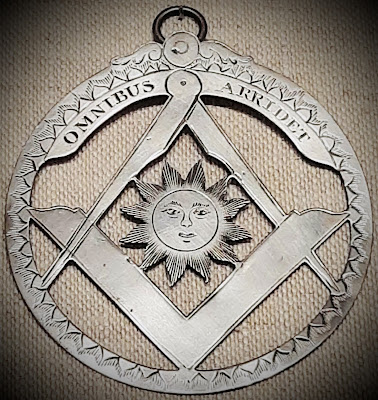
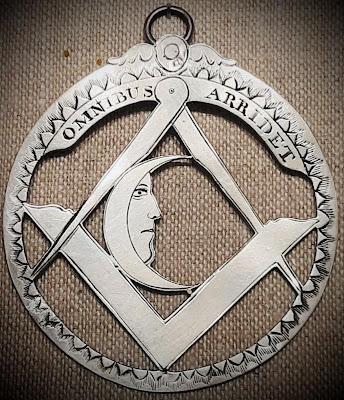
Worcester Art Museum in Worcester, Massachusetts has on exhibit one of those rare sets of silver jewels for lodge officers crafted by Paul Revere.

All photos courtesy Morning Star Lodge AF&AM.

Revere was born January 1, 1735. He was initiated in St. Andrew’s Lodge, a Scottish lodge in Boston, in 1760. He served five terms as Worshipful Master there (plus four in another lodge), and was a Grand Lodge officer for many years. These pieces were made in 1793, two years before he became Grand Master, for the newly instituted (their term) Morning Star Lodge in Worcester.

As you can see, both Deacons’ jewels are inscribed with “Omnibus Arridet,” Latin for “everybody smiles.”

I don’t know what the motto might mean for the lodge. Was it designated to the Deacons because they are the messengers, and a happy countenance is preferable when attending to alarms? Although…

Paul Revere is known to history as an American patriot and as both an artisan silversmith and an artist engraver—but as a young man he became a dentist! During lean economic times in 1760s Boston, the peacetime following the French and Indian War, Paul Revere was in troublesome debt. To get by (and keep his house), he needed what the kids today call a “side hustle,” and so he learned how and then advertised his services as one who could fashion false teeth, at least for the front, using animal bone and ivory. “Everybody smiles” would be a smart tag line for a dentist’s ad campaign.

Seriously though, there is a Latin saying wrongly attributed Marcus Aurelius:

Mors nobis omnibus arridet, homo omnis hoc risum lenem redeuntem facere potest.

Or (maybe):

Death smiles at us all, all man can do is just smile back.

It seems these are good times for Morning Star Lodge. One of the Past Masters was installed Deputy Grand Master last week, and one of their own is the new DDGM. I bet they’re all smiling.

The collection of jewels is on long term loan, as part of a broader exhibit of Revere’s silversmithing, so there’s no need to rush today (although admission is free on first Sundays). Find them in the American Decorative Arts Gallery on the third floor.

WAM is open Wednesday through Sunday, 10 a.m to 4 p.m. 55 Salisbury Street in Worcester.

The most important jewel,
even if they do spell it ‘Tyler.’


Click here to see King Hiram’s Lodge’s Revere jewels.
     

Wednesday, July 21, 2021

‘DeWitt Clinton Lodge AF&AM’


And the third and last post about my recent trip to Massachusetts (see two previous posts) shares several photos of DeWitt Clinton Lodge in Sandwich.

I can attest to DeWitt Clinton’s motto: “The Lodge with the Hearty Welcome.” And it was great to meet, after many years of Masonic cyberspace acquaintance, RW Bro. David Catten.

And speaking of Right Worshipfuls, this meeting, like the previous night at King Hiram’s Lodge, featured the Fraternal Visit of the DDGM. A different district, so a different District Deputy. This time I successfully evaded conscription into the entourage. (Somehow I have forgotten the specific term used for the reception of the DDGM in the lodge.)

It was another great night as a visitor. There are some notable differences in Opening ritual from those I’m used to. Also, a memorial service for departed brethren in which the Master, Wardens, and Senior Deacon place evergreen sprigs on the altar is worth emulating.

Some photos:

The altar, after Closing.

The lodge’s namesake also is a ubiquitous presence in New York Freemasonry, where he served as Grand Master from 1806 to 1819.


U.S. Navy Captain Gerald F. DeConto was raised to the Sublime Degree April 4, 1998. Murdered at the Pentagon September 11, 2001.

Jeffrey W. Coombs was raised to the Sublime Degree December 21, 1983. Murdered aboard American Airlines 11 at New York City September 11, 2001.

‘Cape’ spelled backward.


Sunday, September 6, 2015

‘Boston University Lodge AF&AM’

     
The marriage of colleges and universities to Freemasonry is a subject dear to me, not for the penchant for making more Masons, but for the proximity to education and culture. It’s a natural partnership that we do not see nearly enough. My own dream is to found Perstare et Praestare Lodge (to perservere and to excel) No. 1831 to meet in one of those beautiful townhouses along Washington Square North, but I digress.

Meanwhile in Massachusetts, Boston University Lodge has two events upcoming that you should know about, one this month, and the latter next spring. From the publicity:


Tales from the Vault:
10 Things You Didn’t Know About Masonic Aprons
Thursday, September 24 at 6 p.m.

Open to the public

Boston University Lodge AF&AM
186 Tremont Street
Boston, Massachusetts

As part of the Alumni Weekend events, we have asked Aimee Newell, Director of Collections at the Scottish Rite Masonic Museum and Library, to give a presentation. The event is open to the public. A social period will follow the presentation.

Called “the badge of a Freemason” in Masonic ritual, the fraternity’s apron was adapted from the protective aprons worn by working stonemasons during the 1600s and 1700s. Still worn by members today, the apron remains one of the iconic symbols of Freemasonry. The Scottish Rite Masonic Museum and Library has more than 400 aprons in its collection, dating from the mid-1700s to the present; and made in the United States, England, China, and other countries. Aimee Newell will share examples of aprons from the Museum’s collection, telling stories about their manufacture and use and highlighting new discoveries uncovered in her research for The Badge of a Freemason: Masonic Aprons from the Scottish Rite Masonic Museum and Library (published in 2015). A book-signing will follow the talk. Books will be available for $42.45 (tax included).

Aimee E. Newell previously worked as the Curator of Collections at the Nantucket Historical Association and as the Curator of Textiles and Fine Arts at Old Sturbridge Village. She holds a B.A. in American Studies from Amherst College, a M.A. in History from Northeastern University, and a Ph.D. in History from the University of Massachusetts-Amherst. She is the lead author of Curiosities of the Craft: Treasures from the Grand Lodge of Massachusetts Collection (2013), and the author of The Badge of a Freemason: Masonic Aprons from the Scottish Rite Masonic Museum & Library (2015). Newell writes and lectures frequently on American Masonic and fraternal history.

It’s a no-brainer. If you are in or near Boston, get there.

Next year, the lodge will endeavor something novel and massive: the academic conference. Details will be forthcoming, but save the dates March 31 through April 3, 2016 at the Grand Lodge of Massachusetts for the North American Masonic Academic Convocation. (Yeah, let that phrase sink in for a minute: North American Masonic Academic Convocation.)

Thursday, March 31—Kick-off lecture on Boston University campus.

Friday, April 1—Social outing.

Saturday, April 2—Convocation, break-out sessions, and dinner.

Sunday, April 3—To be determined.

Details are promised to come soon.

The lodge’s 90th anniversary will arrive October 8. Many happy returns, brethren! Many happy returns!
     

Thursday, January 29, 2015

‘That Religion in Which All Men Agree’

     
Looking into spring, and venturing beyond my usual orbit, is this speaking engagement in Boston in April. Dr. David G. Hackett, Associate Professor of American Religious History at the University of Florida, will discuss his book That Religion in Which All Men Agree: Freemasonry in American Culture.


Wednesday, April 8
8 p.m.
Boston University
College of Arts and Sciences
685-725 Commonwealth Avenue
Room 211
Boston, Massachusetts

Presented by the American and New England Studies Program, Hackett will speak on “Enlarging the Field: Freemasonry in American Religious History.”

Admission is free and open to the public, courtesy of both Boston University Lodge and the Grand Lodge of Massachusetts.

I don’t think I will be able to attend, but I expect to review the book and share those thoughts here.


Friday, August 1, 2014

‘Flashback Friday: Marblehead memories’


Today’s Flashback Friday edition of The Magpie Mind takes us to Thursday, April 8, 2010, a day I spent in the car en route to the “New Perspectives on American Freemasonry and Fraternalism” symposium, which would take place the following day at Lexington, Massachusetts. But before heading to my hotel in Lexington, I chose to visit the Marblehead Museum and Historical Society, where an exhibit of Masonic artifacts owned by Philanthropic Lodge, in celebration of the lodge’s 250th anniversary, was closing that very day.

Timing is everything.

Yet again, my notes from this very enjoyable couple of hours are with That Which Was Lost, but I present here more than three dozen photographs of the exhibit and from the lodge itself, courtesy of Bro. Don Doliber, Philanthropic’s highly knowledgeable and motivated historian, who just happened to have made an unplanned visit to the museum when I arrived. (Rashied says there is no such thing as coincidence.) Don curated this collection of centuries-old artworks and other objects. It had been a long time since I’d seen a museum exhibit of Masonic artifacts, outside of a Masonic facility, this extensive and interesting. (One of these days I’ll have to scan and post the photos I shot at both New Jersey’s exhibit at Boxwood Hall in Elizabeth, and the Livingston Library’s exhibit at Fraunces Tavern Museum in Manhattan, both c. 2001.)

Sorry to say the quality of some of these photos isn’t great. I neglected to bring a macro lens to shoot small objects. Many pieces were encased under glass. The lighting in the museum was tricky, with daylight dying in the windows and ceiling lights giving glare and shadows. I had hoped to create a pictorial for The Journal of The Masonic Society, but it didn’t work out, although I did get the unusual square and compasses that you’ll see into the Masonic Treasures section of Issue 11 years ago.

Here is a brief lodge history, found on Philanthropics website:


Philanthropic Lodge was originally chartered as ‘The Marblehead Lodge’ in 1760 by St. John’s Lodge No.1 under the Provincial Grand Lodge of Massachusetts. As this Marblehead Lodge was constituted during the reign of King George III, it was considered an English provincial lodge and all ritual was conducted in accord with English Masonic customs. Thus the Philanthropic Lodge seal bears the initials “F&AM” referring to the “Free and Accepted Masons” traditions of England.


In those early days only 2 degrees were granted to members. Candidates were made Entered Apprentices and Fellow Craftsmen and then were voted members of the lodge. Most of the business was conducted on the 1st Degree. For the first few years, as was the English custom, only the Master was granted the 3rd Degree of Master Mason. Within 18 years the Third Degree was granted to all members.

A 1760 candidate was John Pulling, Jr. (1737-1787), a Marblehead shipmaster, who lived in Boston in 1775. Paul Revere said to John Pulling in April, 1775: “...if the British march by land or sea tonight, hang a lantern aloft in the belfry tower in the North Church Tower, one if by land and two if by sea, I on the opposite shore will be.” … and the rest is history. It is also said that Elbridge Gerry (1744-1814), later 5th Vice President of the United States in 1813, became a member of the Marblehead lodge in 1769.

Its name was changed to “Philanthropic Lodge” in 1797 during the tenure of M.W. Paul Revere, Grand Master of Masons in Massachusetts. The official seal designed sometime after 1798 consists of a 1-inch diameter circle, on the outside of which are the words, “Philanthropic Lodge, F. & A. M., Marblehead, Mass.” Inside the circle is a representation of the Good Samaritan pouring oil and wine into the wounds of a stranger, and above the inside edges of the circle are the words, “This Do Ye.”

The laying of the cornerstone and dedication of the Bunker Hill Monument took place on June 17, 1825 with Grand Lodge Officers and Bro. Marquis de Lafayette present. A delegation from Philanthropic Lodge also attended. Secretary Collyer wrote: “...it was contemplated that there was the largest assembly of people that ever met at one time in the United States of America.”

Philanthropic Lodge originally met at the home of Bro. (Commodore) Samuel Tucker on what is now Prospect Street, Marblehead. Since then, the Lodge has met in several places, one believed to be Tucker Street opposite the end of Mason Street. For the last 63 years we have called 62 Pleasant Street, home.

On March 21, 2006, Philanthropic lodge approved its merger with Wayfarers Lodge of Swampscott by a unanimous vote. On October 5, 2006, M.W. Jeffrey Black Hodgdon for Massachusetts conducted the merger ceremony. With that ceremony, 146 Masons from Wayfarers were enrolled in Philanthropic Lodge.

Philanthropic Lodge is the 3rd oldest Masonic Lodge in Massachusetts and the 19th oldest Masonic Lodge in the United States. It currently enjoys one of the largest memberships (546) in Massachusetts.


Enjoy this look back at a remarkable Masonic lodge’s commemoration of its 250th anniversary in 2010.


Don Doliber, historian of Philanthropic Lodge in Marblehead, Massachusetts, strikes a pose with the portrait of Elbridge Gerry, also a lodge member in the late eighteenth century. Don curated the exhibit presented by the Marblehead Museum and Historical Society in the winter and early spring of 2010.


Bro. Edward Fettyplace (1722-1805) was a charter member of the lodge in 1760.  He held various positions in local government during the Revolution, and served as First Lieutenant of the schooner Franklin in 1776. Read more about this ship below.

Captain Joseph Lemon Lee (1785-1819).

Richard Girdler, a sea captain (1761-1847) joined the lodge in 1834. Portrait painted by William Bartoll.

Don's ancestor John Doliber (1768-1829) joined the lodge in 1809. He too was a sea captain,  owner of the vessels Union, Friendship, Two Sisters, and Five Sisters. Artist unknown, but possibly painted in France.

Philip Bessom (1746-1836) joined the lodge in 1797. Soldier, sea captain, Marblehead Selectman, and Representative to the Massachusetts General Court.

Possibly the lodge's warrant. My notes are gone. Perhaps someone from Philanthropic could leave a comment below.

One sees these punch bowls in Masonic collections up and down the East Coast, and elsewhere I'm sure. This one is of Chinese manufacture, mid nineteenth century. Known as Armorial or Societal China, such pieces were commissioned by American and English consumers. Masonic symbols were sent to China for the porcelain artists to copy.

Dr. Elisha Story (1743-1805) joined Philanthropic Lodge in 1778. A participant in the Boston Tea Party, he also stole a British cannon from Boston Common. Joined the Sons of Liberty, served as a doctor to Colonel Little's Essex regiment, and fought as a volunteer at Lexington and Bunker’s Hill. He aided General Washington on his campaigns to Long Island, White Plains, and Trenton. He was a doctor for the rest of his life at the practice he settled in Marblehead. 

Dr. Story's medical kit. It is said he used this during his service in the Revolution.

Elbridge Gerry painted by William Goodwin. From the lodge’s website: 'Elbridge Gerry was born in Marblehead, Massachusetts on July 17, 1744. He studied at Harvard to be a merchant, graduating in 1762. He was elected to the Massachusetts Legislature in 1773 and was selected to attend the Provincial Congress in 1774. He was a member of the Marblehead Lodge of Masons. He signed the Declaration of Independence. He was then appointed to the Continental Congress, where he was engaged in committee work on commercial and naval concerns. He attended the Constitutional Convention in 1798 but was opposed to the new Federal Constitution, refusing to sign it. He was elected to the first two Congresses from Massachusetts and, in 1797, was one of several envoys sent to France. He was elected governor of Massachusetts in 1810 and 1811. He was much criticized for redistricting the state to the advantage of his own party (Democratic-Republican). That incident was the source of the term gerrymandering. In 1812 he was elected Vice President of the United States. He died in office, on November 23, 1814, at the age of 70.'

John Glover (1732-97) joined the lodge in 1760 as a Charter Member. An illustrious military career before and during the Revolution. Google him.

Elisha Story was Philanthropic's fourth Worshipful Master at the time of George Washington's death in 1799.  For thirty days after Washington's death, the brethren wore armbands similar to this one.

Philanthropic Lodge's Master's gavel, fashioned from wood taken from the USS Constitution.

Medallion profile of George Washington, carved as a decoration for Washington's visit to Salem and Marblehead in 1789. Attributed to Samuel MacIntyre.

Click to enlarge.

Click to enlarge.

Click to enlarge.

Click to enlarge. Masonic apron from the museum's archives.

Click to enlarge.

Replica of the Masonic apron of Richard Harris, a Charter Member of the lodge, and its second Worshipful Master. The original apron is among the collection of the Scottish Rite Masonic Library and Museum in Lexington.

250th anniversary apron depicts the lodge emblem and the historic square and compasses you'll read about below.

Click to enlarge. Captain James Mugford was not a Freemason. A Marblehead hero of the Revolution, he commanded the Franklin, which captured the HMS Hope.

Samuel Russell Trevett (1751-1832). Served in the British army before the Revolution, fought against Britain in the Revolution, and fought the British again in 1812, when he was captured. He was Philanthropic's third Worshipful Master in 1781. In 1779, he was co-owner of the brig Freemason.

Shot of the museum.

Philanthropic Lodge is located at 62 Pleasant Street, just around the corner from its previous digs, appropriately on Mason Street.

A Masonic temple. Remember those?


If I understand correctly, this flag flew on the USS Constitution during its July 21, 1993 voyage, its first in 116 years.

Masonic apron made of kangaroo skin, given to Bro. Floyd Soule during his trip to Australia in 1965...so he may be properly attired there.

Past Master apron of W. Chester Damon, who presided over the lodge in 1931-32.

Best I can tell, this is an invitation to a Brother to attend the lodge's St. John's Day festivities, year unknown.

Click to enlarge. A Dudley Masonic Emblem pocket watch. Read more about that here.

Click to enlarge.


Click to enlarge. There are so many Masonic treasures in the possession of Philanthropic Lodge, including this priceless pair of Great Lights kept at the lodge. The brethren call the set the '1776 Square & Compass.'

On May 17, 1776, the schooner Franklin, commanded by Captain James Mugford, captured the Royal Navy schooner Hope, which wound up providing essential materiel for Gen. George Washington’s forces at Cambridge. Mugford, not a Freemason, was killed in action later that year. The compass, termed a 'divider,' and the square are believed to have been the working tools of the British ship’s navigator. Bro. James Topham, a descendent of Mugford, donated the compass to Philanthropic Lodge in 1858, and then gave the square in 1862. The have been used to make Masons in Philanthropic ever since.