
Showing posts with label Ahiman Rezon. Show all posts

Wednesday, March 4, 2026

‘It’s National Grammar Day’

    
Winding Stairway of the Marietta Masonic Building, Ohio. Those five balusters at center are in the forms of the Five Orders of Architecture. American Union Lodge 1 and Harmar 390 meet here. The temple was constructed by Harmar in 1907-08.

Grammar teaches us the proper arrangement of words according to the idiom or dialect of any particular kingdom or people; and that excellency of pronunciation, which enables us to speak or write a language with accuracy and justness, agreeable to reason, authority, and the strict rules of literature.

William Preston
Illustrations of Masonry
1775

Grammar. One of the seven liberal arts and sciences, which forms, with Logic and Rhetoric, a triad dedicated to the cultivation of language. “God,” says Sanctius, “created man the participant of reason; and as He willed him to be a social being, He bestowed upon him the gift of language, in the perfecting of which there are three aids. The first is Grammar, which rejects from language all solecisms and barbarous expressions; the second is Logic, which is occupied with the truthfulness of language; and the third is Rhetoric, which seeks only the adornment of language.”

Albert G. Mackey
Encyclopedia of Freemasonry and its Kindred Sciences
1917

Arts and Sciences, Liberal. In the seventh century, and for many centuries afterwards, all learning was limited to and comprised in what were called the seven liberal arts and sciences, namely: grammar, rhetoric, logic, arithmetic, geometry, music, and astronomy. The epithet “liberal” is a fair translation of the Latin ingenuus, which means free-born; thus Cicero speaks of the artes ingenuae, or the arts befitting a free-born man; and Ovid says in the well-known lines: “To have studied carefully the liberal arts refines the manners, and prevents us from being brutish.”

And Phillips, in his New World of Words (1706), defines the liberal arts and sciences to be “such as are fit for gentlemen and scholars, as mechanic trades and handicrafts for meaner people.” As Freemasons are required by their landmarks to be free-born, we see the propriety of incorporating the arts of free-born men among their symbols. As the system of Masonry derived its present form and organization from the times when the study of these arts and sciences constituted the labors of the wisest men, they have very appropriately been adopted as the symbol of the completion of human learning.

Albert Mackey
The Symbolism of Freemasonry; Illustrating and Explaining its Science and Philosophy, its Legends, Myths, and Symbols
1867

Grammar is the key by which alone the door can be opened to the understanding of speech. It is Grammar which reveals the admirable art of language and unfolds its various constituent parts—its names, definitions and respective offices; it unravels, as it were, the thread of which the web of speech is composed. These reflections seldom occur to anyone before his acquaintance with the art; yet it is most certain that, without a knowledge of Grammar, it is very difficult to speak with propriety, precision, and purity.

The Standard Work and Lectures of Ancient Craft Masonry
Grand Lodge of New York
2019

Grammar. Is the key by which alone the door can be opened to the understanding of speech. It is Grammar which reveals the admirable art of language, and unfolds its various constituent parts—its names, definitions, and respective offices; it unravels, as it were, the thread of which the web of speech is composed. These reflections seldom occur to any one before their acquaintance with the art; yet it is most certain that, without a knowledge of Grammar, it is very difficult to speak with propriety, precision, and purity.

The General Ahiman Rezon and Freemason’s Guide
Daniel Sickels
1865


Today is March fourth, which is homophonous with “march forth,” which is a complete sentence, which is why today’s date was chosen to be National Grammar Day, so happy National Grammar Day! This occasion was devised by Martha Brockenbrough, founder of the Society for the Promotion of Good Grammar, in 2008.

chicagocopshop.com
“So back to National Grammar Day, which is just one day,” says the University of Illinois. “You’ve heard of red-letter days. Well, National Grammar Day is a red-pen day, a day to correct other people’s grammar.”

Fortunately, there are ways to avoid that.

In his Prestonian Lecture for 1930, titled “The Seven Liberal Arts and Sciences,” Henry Philip Cart de Lafontaine says:

According to the definition of the late Dr. Henry Sweet, a grammar gives the general facts of language, whilst a dictionary deals with the special facts of language. To the ordinary man, grammar means a set of more or less arbitrary rules, which he has to observe if he wants to speak or write correctly; this may be called prescriptive grammar. To a scientific man, the rules are not what he has to observe but what he observes when he examines the way in which speakers and writers belonging to a particular community or nation actually use their mother-tongue; this may be labelled descriptive grammar. The nineteenth century furnished us with another form of grammar, comparative historical grammar, and this should always be supplemented by separative grammar, which does full justice to what is peculiar to each language, and treats each on its own merits. Many things of grammatical importance, such as intonation, stress, etc., are not shown in our traditional spellings. Dialect grammars and grammars of the languages of uncivilized races deal of necessity only with spoken words. Grammar being the basis of all the liberal sciences, it particularly concerns us as Masons to know its rules, for without this knowledge we cannot be acquainted with the beauties of our own Craft lectures, nor can we speak with correctness or propriety. When I reflect on the present slip-shod manner of speech, on the ungrammatical nature of letter-writing, on the loose phraseology of the ordinary novel, and on the atrocious spelling exhibited in letter-writing, I am led to recommend wholeheartedly a return to the study of grammar.
     

Friday, July 19, 2024

‘The meanings of Ahiman and Rezon’

    
See? Facebook is good for something.

Shawn Eyer, one of the “go to guys” in the study of eighteenth century Freemasonry, posted on social media, more than five years ago, a highly useful explanation of a commonly misunderstood point of history. It came up again this week, so I thought I’d share it here (with Shawn’s permission). Enjoy.


Clarifying a Very Old Misunderstanding

In 1756, Laurence Dermott published the first edition of Ahiman Rezon, the book of constitutions for the Masonic Ancients. This was one of the most popular Masonic books of the eighteenth century, with many daughter editions produced in England, Ireland, America, and even in Canada.

At a certain point, the meaning of the title of the book was forgotten by the fraternity, which has led to many bizarre claims. The “historians” who have theorized that these words are pseudohebrew made up by Dermott, nonsense words fabricated to sound confusing, or loan-words from other languages (Portuguese was proposed at one point!) are simply not aware of the context of these two ancient words.

Happily, the Ancients knew Hebrew better than our modern critics who like to say Ahiman and Rezon aren’t Hebrew (even though the ones writing that are not qualified to say it). Ahiman and Rezon are in fact, and quite unambiguously, Hebrew words: names, actually—and both are found in any Bible.

In the Volume of the Sacred Law, there are two characters named Ahiman. The first, an Anakite occupying Hebron, who is conquered by Caleb (Numbers 13:22, Joshua 15:14). But the Ahiman who is relevant Masonically is a later figure—one of a group of Levites appointed by King David to serve a special function in the Jerusalem sanctuary. He was, specifically, one of the four gatekeepers. (1 Chronicles 9: 17–19, 22–31) Dermott included these gatekeepers, especially Ahiman, in his introductory remarks to the original editions of Ahiman Rezon.

Shawn Eyer

Rezon is another character in the Bible: an opponent raised up by God to punish King Solomon after he had allowed his faith to wander. (1 Kings 11:23-25) Read all of chapter 11 for the story.

It is easy to understand why Dermott selected these two names (or why they were potentially emphasized in now-lost Ancients Masonic tradition): Ahiman guarded the holy of holies from the unworthy, Rezon was a thorn in King Solomon’s side during the time of his fall from purity. This is precisely how the Ancients saw themselves in relation to the Moderns.

The perception that these two words were not Hebrew came from attempting to find them in Hebrew dictionaries. Dictionaries typically do not contain names. Just as you won’t find Timothy or Edward in an English dictionary, you won’t find Ahiman or Rezon in a Hebrew dictionary. But they have been Hebrew words since before the second Temple fell.

A takeaway for us all: Before we say that our Masonic forebears were writing nonsense words or dabbling in things they didn't understand, we need to make sure that we are not the ones who are confused.


Saturday, November 19, 2022

‘Scottish Freemasonry Symposium, Part II'

    
Before delving into the content of the presentations at the Scottish Freemasonry in America Symposium of two weeks ago, I’ll share several dozen photos from the guided tour of the George Washington Masonic National Memorial we attendees enjoyed. (I’m not procrastinating. These Magpie posts take time.)

First, the view of the Memorial from the north windows of the Magpie’s suite. Freemasonry’s origins are lost in the mists of antiquity, and the Memorial was lost in the fog.

The famous statue. Bro. Bryant Baker’s big bronze looms in Memorial Hall.
It was dedicated in 1950 by President Harry Truman.

The Alexandria Washington Lodge 22 meeting room.
This sign was posted at the lodge’s previous meeting hall from 1804 to 1944.

Tracing Board of the EA°.

For the FC°.

And for the Sublime Degree.

Where the magic happens.

In the West. Note the placement of J&B.

The desk often has negative connotations, such as being a place of frustrating inactivity, but I bet the lodge secretary doesn’t mind sitting behind this one.
(‘I really just like to be at a desk.’ — Tom Stoppard.)

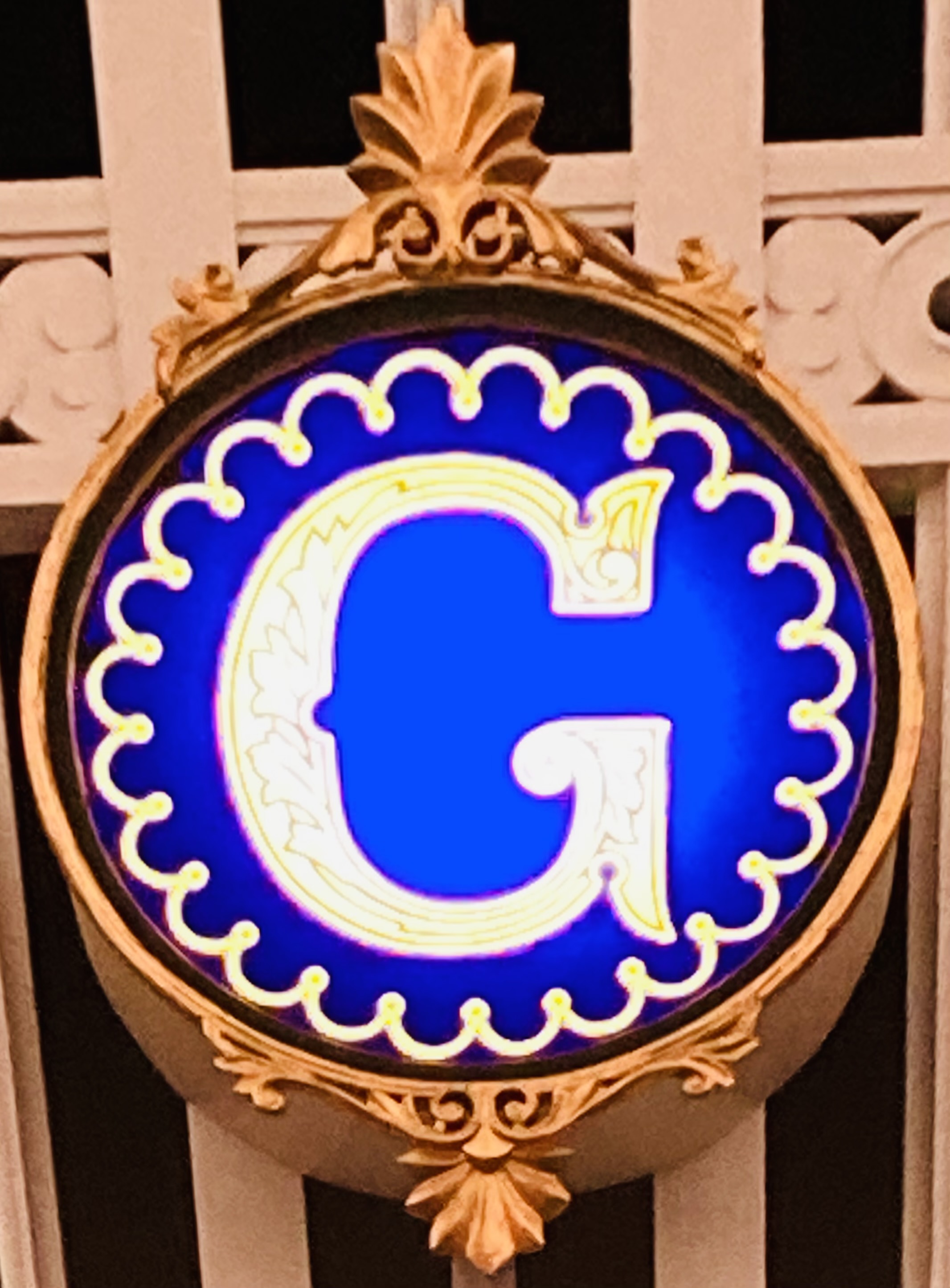
‘In the midst of Solomon’s Temple there stands a G,
A Letter fair for all to read and see,
But few there be that understands
What means that Letter G.’
— Masonry Dissected

And then there is Ye Olde Lodge Meeting Room.
There is an elegance to the small furniture.

The Three Great Lights of Freemasonry.
The Square must have been a Master’s collar jewel at some time.

The Master’s Pedestal.

Speaking of desks, if your Treasurer or Secretary complains about his, just show him what his ancestors had to work with!


This is described at the Memorial as a scarf. The Museum of Freemasonry in London has something similar, which it calls a snuff handkerchief. As much as you wouldn’t imagine unclogging your honker of GAOTU only knows what into a silk piece decorated with our symbols after indulging in a pinch of snuff, it is true that Masons of old adorned all kinds of items with the images of the Craft.

Don’t sit down.


I feel like Jeremy Cross himself gave direction when this was painted.


Replica of the apron presented to George Washington, after victory at Yorktown in 1781, by two merchants in France in recognition of ‘glorious efforts in support of American liberty.’ Bears some resemblance to the Mt. Nebo Apron, n’est-ce pas?

Replica of the gavel Washington employed in the cornerstone dedication of the U.S. Capitol in 1793. The original is custody of Potomac Lodge 5 in the District of Columbia. New Jersey’s research lodge once possessed a replica too, a gift from MW David A. Chase, who set us to labor. Sadly, someone ‘borrowed’ it years ago when we met in the Trenton Temple.

Various exhibits abound inside the Memorial. Here is a fiftieth anniversary loving cup, and a gorgeous specimen too, from Kane Council 2 of Royal and Select Masters in New Jersey. Kane would have reached its 162nd anniversary next Saturday, but its charter was revoked recently. I’ll be exposing that ugliness in an upcoming edition of The Magpie Mason.

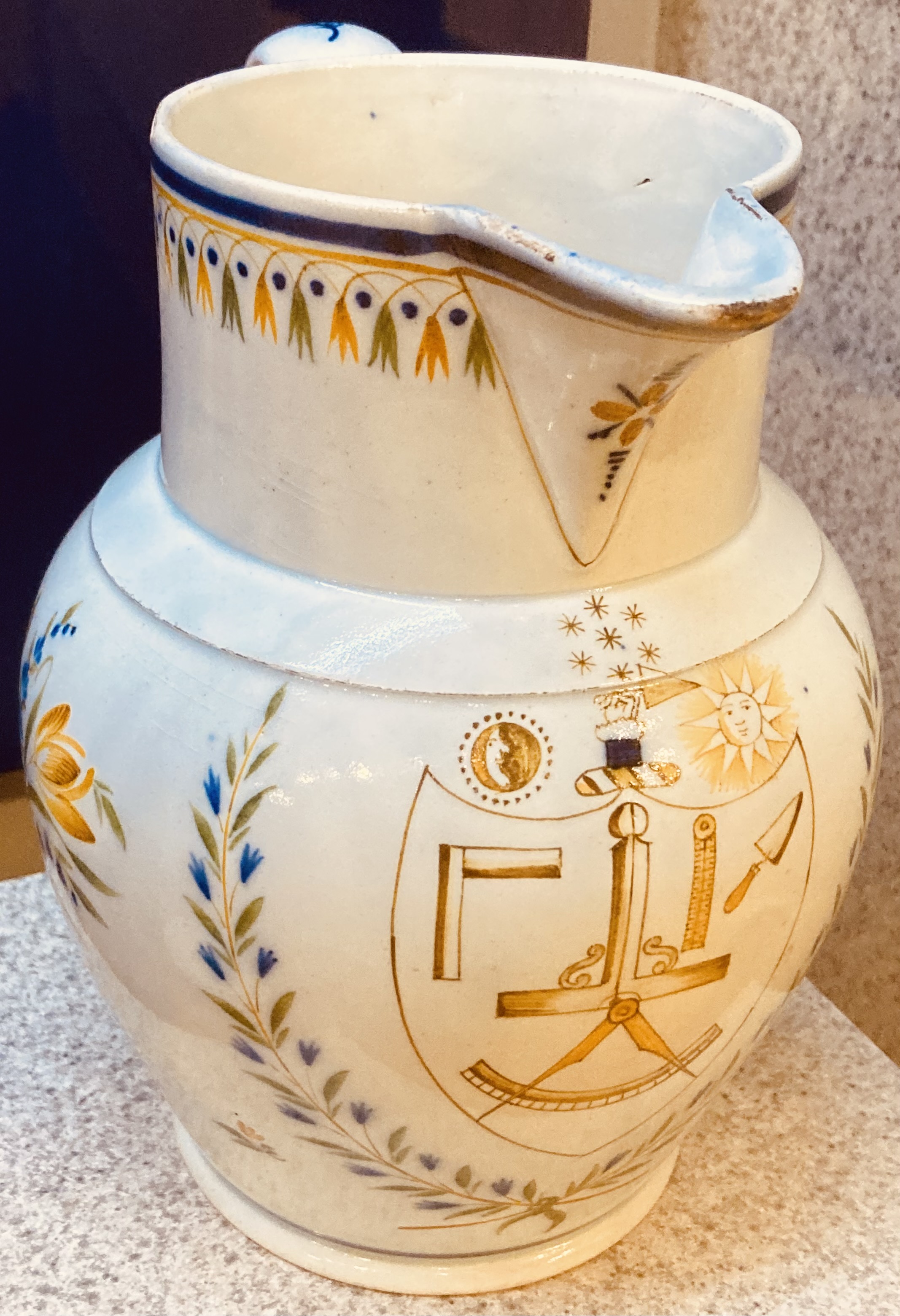
Ceramic pitcher from Liverpool, England.
I’m imagining many servings of punch. Vivat!

I love the porcelain and ceramic and glass pieces of yore.
Masonic material culture today is so chintzy and uninspiring. 

St. Paul’s Lodge 481 commissioned this pipe tobacco humidor to commemorate the 125th anniversary of the Grand Lodge of Pennsylvania in 1911. Beautiful piece, and I’m not just editorializing because of my fondness for the pipe! See photos of an identical jar here. Like the Kane Council cup, this, and a whole lot of other Masonic ceramics, were manufactured in Trenton, New Jersey.

Outstanding.

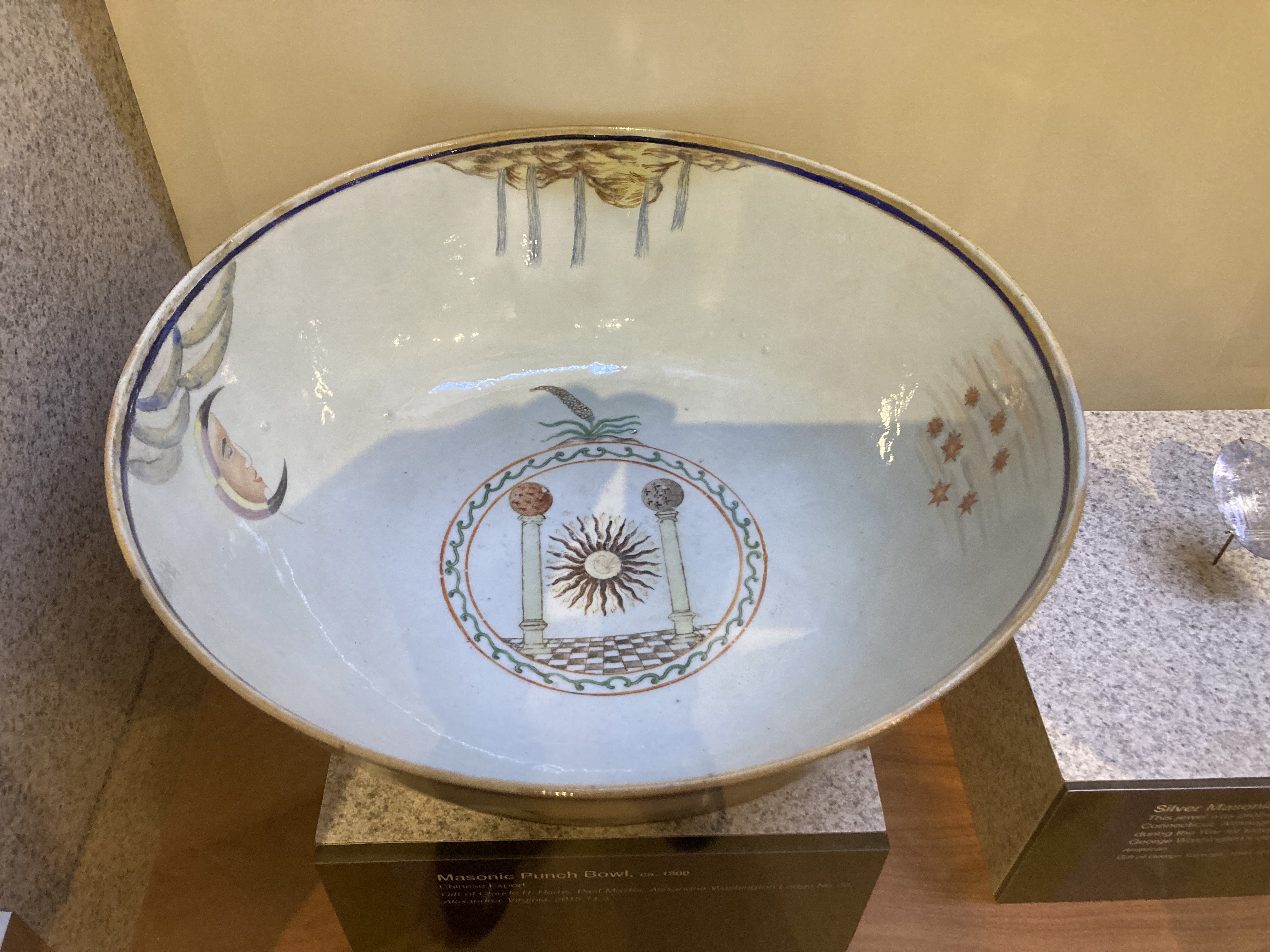
These punch bowls are found in Masonic museums up and down the East Coast,
and elsewhere, I’m sure. Made in China during the 1790s.

Good fire!

Glass flask.

Scrimshaw carving on bone or ivory was popular among sailors back in the day.

I’ll guess this is an English apron circa 1800. I forgot to take note of the identifying card that surely was next to this.


Aprons made of simple paper are used at meetings that draw large groups to accommodate all those who didn’t bring their own regalia. President Franklin Roosevelt (Holland Lodge 8) had two sons, James and Franklin, Jr., who were raised in Architect Lodge 519. This must have been a wing ding. In attendance were the Grand Master, Mayor LaGuardia, several state Supreme Court judges, and other dignitaries.

Ahiman Rezon originally was the book of constitutions of the ‘Ancients’ Grand Lodge circa 1751. In America, when home grown grand lodges began to organize in the former colonies, some of those identifying with the Ancients chose Ahiman Rezon as the title of their respective constitutions (e.g. Pennsylvania, South Carolina, maybe others). This text is the Grand Lodge of Pennsylvania’s printed in 1783. What does the term mean? You’ll find different explanations in Masonic literature, such as the Hebrew for to help a brother or something similar. Im going with Shawn Eyers explanation: ‘Both Ahiman and Rezon are names from the Bible. In fact, the Biblical character Ahiman appears in the Ahiman Rezon, which lets you know immediately that all those who claim it is a mystery what Ahiman means have not bothered to read the book and don’t know their Bible.’

Sigh. Book publishing in the nineteenth century.

This beer can was left in the attic during construction of the Memorial in the 1930s.

There are other statues of Washington about the Memorial. New Yorkers ought
to recognize this one from its gilded twin inside the Hollender Room of Masonic Hall.

In the Louis A. Watres Library, they found space for Mark’s new book.

And, in closing, the ‘view’ that morning from the observation deck.