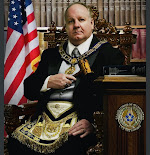
This just in: Ill. Cliff Jacobs,
33° is the new Commander-in-Chief of New York City Consistory, having been
installed into the symbolic chair of Frederick the Great last night.Wednesday, June 6, 2012
‘Cliff-in-Chief’
This just in: Ill. Cliff Jacobs,
33° is the new Commander-in-Chief of New York City Consistory, having been
installed into the symbolic chair of Frederick the Great last night.
(three “Huzzahs!” here)
Illustrious Jake, as he sometimes
is known, is one of the guiding lights in the New York City Masonic renaissance
of recent years, active in Craft Masonry and beyond. He received the degrees of
Scottish Rite Masonry in 1990, and was coroneted a 33° Mason in 2008.
If you share his passion for fine
writing instruments, follow his blog here.
Illustrious Sir, if you ever need me for anything, just let me know.
Tuesday, June 5, 2012
‘Astronomy: Transit of Venus’
I usually sleep through the rare astronomical wonders, but I hope to catch this one, since the sun will be up.
From National Geographic:
“This Tuesday or Wednesday, depending on where you live, sky-watchers around the world will be able to see a cosmic spectacle known as a transit of Venus. The events are so rare that only six Venus transits have been observed since the invention of the telescope more than 400 years ago.”
From NASA:
“This is the Official Sun-Earth Day webcast for the Venus Transit brought to you live from the summit of Mauna Kea, Hawaii.”
From The New York Times:
“The rare astronomical event, known as the transit of Venus, comes in pairs about once every century, with the previous one occurring in 2004. The next one will not take place until 2117, making the event on Tuesday truly a last-chance opportunity. Unless, of course, it rains.”
Friday, June 1, 2012
‘Anderson’s Constitutions’
| Title page of first edition of Benjamin Franklin’s 1734 reprint of Anderson’s Constitutions. This copy is among the special collections of the University of Pennsylvania in Philadelphia. |
The Second Masonic District
Book Club’s June meeting will be devoted to a discussion of Anderson’s
Constitutions.
Monday, June 25
Monday, June 25
7:15 p.m.
99 South Maple Avenue
Ridgewood, New Jersey
All Master Masons are welcome. Click here to download the club’s recommended copy of the document, an electronic version of BenjaminFranklin’s 1734 reprint of the 1723 English
original. If you didn’t know, Franklin’s reprint was the first Masonic book
published in the New World. The patron of printers in America made a verbatim
copy at a time when only the earliest of Masonic lodges in the American
colonies were extant. Tun Tavern in Philadelphia, Green Dragon in Boston, and
Solomon’s Lodge in Georgia each, in its own way has claim to be the oldest
lodge in America, but there weren’t many more here in the early 1730s. It also
should be noted that Franklin became Grand Master of Pennsylvania (Moderns) the
year he printed the Constitutions, on Saint John Baptist Day.
I am looking forward to this discussion. Anderson’s
Constitutions may be the most important but most misunderstood text in Masonic
letters. We today look upon its First Charge, that “Concerning God and
Religion,” allowing our modern eyes to misinterpret how it codified religious
tolerance among the various Christian factions of 1720s London as something
universal, a taste of the multiculturalism that indulges 21st
century sensibilities. Its terminology (e.g. “stupid atheist” and “irreligious
libertine”) is not as clear and blunt as we today assume. There is much room
for discussion right there.
The second most famous aspect of the document is its lengthy “history” of Freemasonry. Needless to say it is a legendary history tracing the transmission of Masonry, or Geometry, from Biblical patriarchs and prophets to ancient Egypt, Greece, and Rome; to the Saxons, Danes, and Normans; to Plantagenets, Tudors and Stuarts; to the Duke of Montagu – “the most noble Prince” and the Grand Master of Masons.
You neo-Templars out there would be wise to notice the absence of any mention of the Crusades and Knights Templar, or any other marauding army that killed so many infidels in the name of the Prince of Peace. The thinking of Masonic origins, at least at the official level of that time, had not yet heard the myth of Templar beginnings of Freemasonry.
But there will be time to talk about it all June 25. Hope to see you there.
All Master Masons are welcome. Click here to download the club’s recommended copy of the document, an electronic version of Benjamin
The second most famous aspect of the document is its lengthy “history” of Freemasonry. Needless to say it is a legendary history tracing the transmission of Masonry, or Geometry, from Biblical patriarchs and prophets to ancient Egypt, Greece, and Rome; to the Saxons, Danes, and Normans; to Plantagenets, Tudors and Stuarts; to the Duke of Montagu – “the most noble Prince” and the Grand Master of Masons.
You neo-Templars out there would be wise to notice the absence of any mention of the Crusades and Knights Templar, or any other marauding army that killed so many infidels in the name of the Prince of Peace. The thinking of Masonic origins, at least at the official level of that time, had not yet heard the myth of Templar beginnings of Freemasonry.
But there will be time to talk about it all June 25. Hope to see you there.
Thursday, May 31, 2012
‘That High and Lonesome Sound’
Posting this unexpected interesting announcement makes the sad news about the death of Doc Watson yesterday a little easier to take. The Ninth Manhattan District’s German Masonic Charitable Foundation will host its first Traveling Man Bluegrass Festival next month at its German Masonic Park in Tappan.Traveling Man Bluegrass FestivalSaturday, June 16, from noon to nineGerman Masonic Park120 Western HighwayTappan, New YorkTickets are $25 each, and a portion of each sale will be donated to the Masonic Medical Research Laboratory for Sudden Infant Death Syndrome research and other efforts into SIDS research.Tickets are available here.
Wednesday, May 30, 2012
‘Light and meditation’
Historic Munn Lodge No. 203 will host a Festive Board June 14 to honor W. Milton Sporn for his contributions to the Craft, AND the occasion will be marked by a lecture delivered by W. Lenny Lubitz titled “The Influence of Light and Meditation in Masonic Ritual.”
Lenny is a friend of the Magpie. We frequent the same venues, from ALR to ICHF and more. I know he regards Masonic education very seriously, so I do not hesitate to recommend hearing him speak.
Cost is only $25 per person, and the event is open to Apprentices and Fellows.
Labels:
Bro. Lenny Lubitz,
festive board,
Munn Lodge 203
Monday, May 28, 2012
‘Freedom is a light’
Facing Independence Hall is George Washington, standing in one of only five public squares
planned in William Penn’s 1682 survey of Philadelphia.
|
| “Freedom is a Light for which many men have died in darkness” is the main inscription on the Tomb of the Unknown Soldier in Washington Square Park in Philadelphia, Pennsylvania. |
Today I’m just repeating a previous Memorial Day post, but with a different angle.
In everyday life, I think most people forget the meaning of patriotism, allowing that unifying virtue to be blended with what really is jingoism, or at best a “me too” moment, free of commitment or sacrifice.
As is often the case, the rituals of Scottish Rite Masonry help me make sense of such concepts. The Master of the Symbolic Lodge Degree (20ยบ) in the A&ASR Southern Jurisdiction puts it succinctly:
“Patriotism, willing to sacrifice itself for the common good, even when neither thanks nor honor follow it; that asks not whether that which the country requires will or will not be popular, but does the right without regard to consequences. Let there be Light!”
Again it is Scottish Rite that says it all. From the Chapter of Rose Croix: “So may the Light that never fails, the Love that never forgets, and the Life that never ends, illumine our world.”
SMIB.
Saturday, May 26, 2012
‘To keep and not conceal’
For you library conservators and museum curators out there, the
Chancellor Robert R. Livingston Masonic Library will welcome a pro next month to present a
program on how best to handle, store, preserve, and display Masonic
papers, certificates, and other materials. Ms. Andrea Pitsch, who holds a
Master’s Degree in Art Preservation, also encourages attendees to bring
specimens, so she may offer informed advice on specific items. A lively Q&A
session is anticipated as well.
Tuesday, June 12
6 p.m.
Masonic Hall, 14th Floor
71 W. 23rd St.
New York City
RSVP (required) to (212) 337-6620 or
info(at)nymasoniclibrary.org
This is a service being brought to you by the Library Trustees
to assist you in the vital preservation of archives, books, and other records
that both conserve and transmit Masonic history. A step beyond saving the
archives of Masonry from inundations and conflagrations.
Labels:
Livingston Library,
Masonic Hall,
Ms. Andrea Pitsch
‘The Temple of Solomon’
Author James Wasserman will return to the Chancellor Robert R.
Livingston Masonic Library for another speaking engagement next month, Director Tom Savini announced this week.
Wednesday, June 6
6 p.m.
Masonic Hall, 14th Floor
71 W. 23rd St.
New York City
Wasserman will discuss his book The Temple of Solomon, “a
lushly-illustrated exploration of the Temple in history and legend.” (His
publisher will have copies of the book available for purchase in both hardcover
and softcover formats, as well as limited copies of the author’s other works.)
Attendance is free, and open to the public.
Labels:
James Wasserman,
KST,
Livingston Library,
Masonic Hall
‘Observing the Craft’
Retrieved recently from a dead PC is my review of Bro. Andrew Hammer’s terrific book Observing the Craft written for The Journal of the Masonic Society. I didn’t know Hodapp already had written a review for the publication, so this review might as well have been lost in a hopelessly infected and disabled computer. But it was resurrected, with some other files, by a wizard earlier this spring, just in time to submit to Cory Sigler for his first issue of the new The New Jersey Freemason magazine, which arrived in the brethren’s mailboxes a week ago. I only had to dust it off, trim a few words, and click send.
Now, if I can get my thousands of JPGs off that computer, I’ll be a happy man.
Observing the Craft: The Pursuit of Excellence in Masonic Labour and Observance
By
Andrew Hammer
Mindhive
Books, 2010, 145pp.
![]() |
| Click here to order your copy. |
For
context, it should be understood that Bro. Hammer is not a typical American Mason.
A native of the United Kingdom (which explains his book’s British spelling), he
is a Past Master of Alexandria-Washington Lodge No. 22, which meets inside the
George Washington Masonic Memorial in Alexandria, Virginia. The ethos he helped
bring to this historic lodge in the previous decade is summarized in a plain
statement to prospective petitioners. I paraphrase: “The question is not ‘Can I become a Mason?’ There are many lodges in
the area that will be glad to have you. The question is ‘Can I become a Mason
in Alexandria-Washington Lodge?’” This is not arrogance, but it is a reason
why his lodge was dubbed the Grand Lodge of Northern Virginia, a sobriquet
bestowed unkindly by Virginia Masons who instead should have been taking note
of A-W’s revival under the leadership of Hammer and his colleagues. In the
revitalization of Masonic lodges taking place across the country in recent
years, Hammer’s touch is felt thanks to his leadership in the Knights of the
North think tank, The Masonic Society educational fraternity, other organized
proponents of Masonic renaissance, and of course this book.
Observing the Craft is audacious in its phrasing, but its thinking
is so fundamental as to be irrefutable. It is, after all, paraphrasing the teachings
of the lodge. When Hammer challenges the flawed belief that more men equals a
stronger fraternity, which leads to mass initiations, he says “The very essence
of membership in the Craft is not about bringing people in, for whatever
reason… the essence of membership in the Craft is that it must be sought.” He essentially
is reminding us of the Entered Apprentice Charge, which urges us to be cautious
in recommending a man to the lodge because it is the mysteries of Masonry that
distinguish us from the rest of the community. And where that charge warns us
against arguing with the ignorant that ridicule Masonry, Hammer insists “If we
are to be consistent in that charge, then we must also not suffer ourselves to
placate prying eyes or the mindless paranoia of philistines.” Not a motto for
Square and Compass Day.
Addressing
charity, the author describes it as “the perfection of every virtue,” something
with which we all can agree, but he is fearless in making the distinction, long
forgotten in Masonry, that “Masonic charity is not material benevolence.
Rather, it is the spiritual and philosophical awakening which motivates it.” Does
not the lecture of the First Degree instruct us, on the subject of Relief, in
acts of emotional and psychological kindness?
The
author also writes at length on tangible aspects of lodge life, namely dining,
dress, and ritual. Of the first item, Hammer takes us to the Festive Board, a
stylized Masonic meal (not to be confused with the Table Lodge) that follows
the tiled meeting, but continues the decorum of that meeting. “The guiding idea
is that the food should be of the same quality one would find in any fine
restaurant, and it should be presented and served in a way that conveys dignity
even if served on paper plates.” In ambiance, the Festive Board is a place of
good cheer, where the brethren may speak candidly, offer toasts, and basically
balance the solemnity of the lodge meeting with the joy of fellowship.
As
regards dress, Hammer explains that attire is nothing less than a Mason’s
“physical manifestation of his effort to bring his mind and soul to a state of
excellence.” The specifics are best left to the lodge, but “No one should dress
differently for lodge than they would to attend their house of worship or take
part in any other important event in their lives.”
On
ritual, it is “perhaps the single most important aspect of observing the Craft”
and “what transforms a room into a lodge, the men in that room into Masons, and
the profane into the sublime.” It goes without saying, so Hammer gently reminds
that the performance of our rituals to the highest levels of proficiency is the
primary goal, but his larger point concerns ways to “excite the curiosity of
all observant Masons.” Urging us all to always work within the guidelines of
our respective jurisdictions, the author suggests the following:
- Confer the degree on one man only so he makes an individual journey, and is the center of the lodge’s attention.
- Employ music to “elevate the assembly of minds gathered together” and to accentuate different aspects of ritual work at specific times. Conversely, use silence to remove all distractions from the sense of hearing. Obviously, this means no chatting on the sidelines, but also much more for the benefit of everyone’s state of mind.
- To further assist the focusing of the mind, light and darkness must be properly managed. “Darkness, like silence, concentrates the mind by removing all other distractions” and the light revealed to the candidate when the hoodwink is removed should be only “a simple flame,” so no other “competing visual images” enter his mind. That’s the moving flame of the candle, mind you, and not the kitschy “Masonic light bulb.”
- Appealing to our sense of smell, Hammer praises incense. The sense of touch can be addressed through what is called the Chain of Union, the interlocking of arms and clasping of hands to achieve “psychological and physical union” around the entire lodge room.
Clearly,
to Andrew Hammer, Freemasonry is a verb. To observe the Craft is to take up the
Working Tools and thoughtfully go about our labors in self-improvement, but
doing so harmoniously together. It’s all explained in our rituals, lectures,
charges, and other orations. The trick is to not be content with merely
memorizing and reciting all that inspiring literature, and instead to animate
it by doing what it advises. In his concluding paragraphs, Hammer explains
“This book was written in an attempt to call the Craft from refreshment to
labour. That labour involves confronting our fear with dignity; it involves
standing up for the ideas of free thought and free association in the face of
those who would demand we eviscerate our mysteries before their altars of
cloying superficiality; it involves respecting ourselves enough to say that we
must not be afraid to reach for more light within ourselves, that light of the
contemplative spirit within each of us that cannot be meted out to curious
bystanders just because they want to see it.”
It is
the blueprint – if you will, the designs upon the trestleboard – for a
successful lodge of skilled craftsmen. How many of us will heed the sound of
the gavel?
Wednesday, May 23, 2012
‘The Challenge of Rudolf Steiner’
![]() |
Courtesy Cupola Productions.
|
The screening, accompanied by a lecture, will take place Tuesday, August 14 at 8 p.m.
New York Open Center is located at 22 East 30th Street, near Madison Avenue, in Manhattan.
From the publicity:
Tonight the director of this long-awaited film introduces his new work. Shot in Austria, Switzerland, India, the United Kingdom and the United States during 2011—the 150th anniversary year of Rudolf Steiner’s birth—this documentary looks not only at the biography of this remarkable visionary and philosopher, but also at his world-wide legacy in education (Waldorf Schools, Camphill), agriculture (Biodynamics), medicine (Weleda, Hauschka), and all areas of social and spiritual life. At the heart of this film lie the classic questions: Where do we come from? What are we? Where are we going?
Admission costs $20 for members of NY Open Center, and $22 for non-members.
(How New York Open Center called dibs on the debut, over the Anthroposophical Society, is unknown to me.)
Click here to see the trailer.
Subscribe to:
Posts (Atom)