Friday, July 10, 2009

He coined G.A.O.T.U.

Happy birthday wishes to the man who coined the phrase “Great Architect of the Universe.” Yes, John Calvin would be 500 years old today. Among the world’s major religions, Calvinism is kind of a youngster, but its importance to Protestantism and its indirect benefit to Freemasonry are very important.

It was Calvin, the legendary French troublemaker, who coined that phrase in his “Commentary on Psalm 19,” which sometimes is translated to say Supreme Architect.

(The 19th Psalm itself is worthy of every Junior Warden’s attention.)


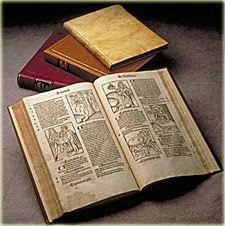
But the idea of God being a kind of cosmic architect predates Freemasonry by even more centuries. Depictions of this nature are found in medieval Christian art. The “Bible Moralisée,” published about 1250 AD, shows God busy at work with compasses in hand.

G.A.O.T.U. was introduced into Freemasonry by Dr. James Anderson, author of the Premier Grand Lodge’s first Book of Constitutions in 1723. A Presbyterian minister himself, Anderson is a theological descendant of Calvin. However, I’d say the credit for making the phrase Masonic vernacular belongs to Albert Mackey who used the term in his groundbreaking list of Masonic Landmarks, which has affected the jurisprudence of our grand lodges since its publication in 1858. And then of course there is the Scottish Rite and its siblings, which employ the term in prayer and ritual. (Photo courtesy GL of British Columbia and Yukon.)

Cushite at labor

Senior Warden Rob Morton, Sovereign Master David Lindez, and Bro. Steve rally around the altar at the Hunter Estate, the private home where Cushite Council No. 474 held its first meeting July 3.


An interesting development in New Jersey Freemasonry is the current proliferation of AMD councils. If you are not familiar with the Allied Masonic Degrees, it is an honorary, invitational fraternity within the York Rite. Membership is predicated on Royal Arch membership, and the AMD is supposed to be devoted to research and education, and the preservation of a corpus of very interesting degrees that long ago were worked in lodges, but later were discarded, and finally were collected under the authority of the AMD.

Anyway, two AMD councils are being set to labor in New Jersey, with talk of a third on the way. DaVinci Council is forming in central Jersey, and Cushite Council No. 474 held its ceremony of constitution and first meeting last Friday. The third council is in an embryonic phase in north Jersey, but I’m sure it’ll come together and begin functioning soon.

You might recognize the name Cushite. In the Bible, Cush was the son of Ham. He and his people inhabited the land called Cush, which we know today by its Greek name Ethiopia. In Freemasonry, Cushite Lodge was to be a lodge set to labor in Newark, New Jersey in 1870. The Grand Lodge denied the petition for a warrant. The brethren aiming to form Cushite Lodge instead organized Alpha Lodge No. 116, whose Worshipful Master today is W. Bro. David Lindez, the Sovereign Master of the new Cushite Council.

(I won’t attempt to summarize the history of this process, which is very complicated, involves race relations, and has been told by more competent writers. A quick Google search will yield GLNJ proceedings and other trustworthy sources of this exciting time in 19th century Masonic history.)

I think just about all of Cushite Council’s brethren come from Alpha Lodge and Alpha Chapter. But there was one special guest at this first meeting last Friday: Bro. Balvin came all the way from North Carolina, making John Candy’s travels look like a hansom cab ride in comparison.

Cushite AMD Council plans to meet in a local restaurant, returning Masonry in one respect to its tavern roots. “Eat, drink, and be Masons,” I always say.

The first paper presented in this new council was presented by Bro. Steve, who spoke on the symbolic and numerological significances of the number 27. Citing Biblical, Pythagorean and other esoteric sources, Steve linked the permutations of the three-fold number to various elements in Masonic ritual and symbol. Well done!

Next up was the Sovereign Master’s paper on the August Order of Light. Also very enlightening.

All in all, it was a great start for a council that will be productive for many years.

I feel a verse is imminent!

Deity was invoked,
and incense was lit.
Masonry was worked,
and whiskey was sipped.
Cigars were smoked,
and Balvin finally made it.


Bro. Balvin joins V. Lindez in the East of Cushite Council.

This fall at ALR

Another reason to look forward to fall is the next Regular Communication of American Lodge of Research on Thursday, Oct. 29 at 8 p.m.

This will be the Annual Meeting, with the election of officers, and WM Bill Thomas announces the paper presented that evening will be “The Anti-Mason’s Toolbox: Abusing Logic to Attack the Craft” by W. Gilbert Ferrer. “An introduction to the logical fallacies underlying some typical arguments of contemporary Anti-Masonic zealots. The focus will be on debating tactics zealots use to avoid having to prove their allegations against the Craft.”

The lodge meets in the French Ionic Room at the Grand Lodge of New York, located at 71 W. 23rd St. in Manhattan.

Before the meeting, brethren are welcome to join the lodge’s officers for dinner at the Limerick House Pub next door at 6 p.m.

Thursday, July 2, 2009

Opportunities for scholars

Here are two opportunities for Masonic scholars to present their work and maybe earn a little praise as well.

Pythagoras Lodge of Research in Washington, DC invites the brethren to participate in its Masonic Research Awards Program, intended to encourage research and education work.

From the official announcement:

The following criteria will be used to evaluate all submissions:

Originality: The topic introduces new ideas, innovative concepts, unfamiliar resources, and/or creative methods. Topic is the writer’s choice.

Masonic connections: Interesting, informative, and innovative references to Masonic symbolism, ritual, practices, history, etc. are included.

Style: The author displays a thorough knowledge of the content. Alternative viewpoints are legitimately presented. The content is characterized by clear, unmistakable evidence, and focused on the central statement (thesis) or research topic with effective transitions between points.

Content: All information is well arranged with compelling presentation of the issue, question or problem. The research is supported by an investigation of facts and a development of the ideas. The paper is closed with strong supporting points that underline or expand the central postulate.

Persuasion: The concluding position provides coherent argument illustrative of critical analysis and a thoughtful level of inquiry, supported by well-founded, fact-based solutions and/or cause and effect relationships.

Format: The presentation is neat, correct and consistent in appearance, including margins, font size, indentations, titles, quotations, etc.

Grammar: The research paper is free of errors in terms of sentence structure, punctuation, spelling, and mechanics.

Person: The research paper is presented in perspective of Third Person focusing attention on the work, not on the author. Personal essays are not encouraged.

Citations: The bibliography demonstrates sufficient synthesis of relevant literature and practices. Citations are embedded, footnoted, and quoted correctly. A minimum of three external sources should be included.

Summary: An abstract briefly provides the key elements, main findings, and overall conclusions of the research.


Entries are to be submitted as Word documents by e-mail to W. Bro. Ted Berry at eab_dc(at)yahoo.com no later than October 31.

By submitting a paper, the author recognizes that such entries might be included in Pythagoras Lodge publications and/or forwarded to other Masonic research bodies for inclusion in their publications, with appropriate attributions.

Three medals will be awarded.

▲▼ ▲▼ ▲▼ ▲▼ ▲▼ ▲▼ ▲▼ ▲▼ ▲▼ ▲▼ ▲▼ ▲▼ ▲▼ ▲▼

In addition, the National Heritage Museum, located at the headquarters of the Ancient Accepted Scottish Rite Northern Masonic Jurisdiction, is planning for its first symposium in what is hoped will become a bi-annual tradition.

“New Perspectives on American Freemasonry and Fraternalism” will take place April 9, 2010 at the museum in Lexington, Massachusetts.


From the official announcement:

Recently, a call for papers was issued, and we are pleased to announce that response has been brisk.

The symposium seeks to present the newest research on American fraternal groups from the past through the present day. By 1900, over 250 American fraternal groups existed, numbering six million members. The study of their activities and influence in the United States, past and present, offers the potential for new interpretations of American society and culture. Diverse perspectives on this topic are sought; proposals are invited from a broad range of research areas, including history, material and visual culture, anthropology, sociology, literary studies and criticism, gender studies, political science, African American studies, art history, economics, or any combination of disciplines. Perspectives on and interpretations of all time periods are welcome.

Possible topics include:

• Comparative studies of American fraternalism and other international forms
• Prince Hall Freemasonry and other African-American fraternal groups
• Ethnically- and religiously-based fraternal groups
• Fraternal groups for women or teens
• Role of fraternal groups in social movements
• The material culture of Freemasonry and fraternalism
• Anti-Masonry and anti-fraternal movements, issues and groups
• Fraternal symbolism and ritual
• The expression of Freemasonry and fraternalism through art, music, and literature
• Approaches to Freemasonry from disciplinary, interdisciplinary, or transnational perspectives; the historiography and methodology of the study of American fraternalism

If you know anyone interested in submitting a proposal, these are the details: Submit an abstract of 400 words or less with a resume or c.v. that is no more than two pages. Be sure to include full contact information (name, address, e-mail, phone, affiliation).

Send proposals to: Aimee E. Newell, Director of Collections, National Heritage Museum, by e-mail at anewell(at)monh.org or by mail to 33 Marrett Road, Lexington, MA 02421.

Deadline for proposals to be received is August 15. For questions, contact Aimee E. Newell as above, or call 781-457-4144.

‘52nd annual Hill Degree’

It’s that time of year already. Mt. Anthony Lodge No. 13 in Vermont will host its 52nd annual “Hill Degree” later this month in Bennington.

The official announcement:


Mt. Anthony Lodge #13 F&AM cordially invites all Master Masons and their families to Bennington Vermont for the weekend of July 24th - 26th, 2009.


Master Masons are welcome to attend the 52nd Anniversary Hill Degree on July 25. The HILL DEGREE is a day of fraternal brotherhood and the conferment of the Master Mason degree on one or more candidates. The first section the degree is worked in our historic lodge room. Officers of the Grand Lodge of Vermont will perform the first section degree work. Following the first section, all are invited to a great steak dinner (open to the family) on the outskirts of town. The second section is done in full costume at an outdoor natural amphitheater at dusk.


For information on registration, accommodations, etc., click here.

Wednesday, June 24, 2009

‘Is Summer over yet?’

This edition of The Magpie Mason is dedicated to Bro. Gallant, who is in search of New York lodges that work Scottish Rite ritual.

Here is a reason to look forward to autumn: Garibaldi Lodge No. 542 will confer its world famous Entered Apprentice Degree on Friday, October 9. The Friday before Columbus Day.

The lodge will open at 8 p.m. in the Grand Lodge Room (third and fourth floors) at the Grand Lodge of New York, located at 71 West 23rd St., near the corner of Sixth Avenue, in Manhattan.

This degree draws visiting brethren from all over the world. The last time I attended – April of last year, I think – the visitors were called upon to introduce themselves, and they hailed from lodges across the United States, and indeed all over the globe. The Grand Lodge Room accommodates approximately 1,200 people, and believe me when I tell you that every seat in the room was occupied. (In fact, the first time I attended – April of 2001, I think – four hundred Masons, mostly those who arrived late on their buses from Pennsylvania, had to be turned away to placate the Fire Marshal, who was poised to close down the building for safety’s sake.)

If you plan to attend, be at the front door of Grand Lodge at 6 p.m. Bring your regalia and membership identification.

But that reminds me of another important observation. The last time I attended an EA° at Garibaldi in the fall – October of 2003, I think – the room was nearly empty. I was able to get one of the best seats in the house, and I’m not saying where that is.

Other facts you should know:

• Born on the fourth of July 1807, Giuseppe Garibaldi is regarded as “the George Washington of Italy” because his military and political skills were crucial to the unification and establishment of the modern Italian nation-state. And he was not limited to that nation; Garibaldi also fought for independence in Brazil and Uruguay. (It was then that he adopted the red shirt as symbolic attire. At Garibaldi Lodge, you’ll see the officers wearing red dress shirts with their tuxedos.)

After revolutionary exploits in Italy in the late 1840s, Garibaldi went into exile in of all places... Staten Island, New York. So there is a physical proximity of the lodge to its heroic namesake, as well as the ethnic unity. Because of his sojourn in New York City, there is a terrific statue of Garibaldi in historic Washington Square Park. The bronze depicts the warrior with his hand on the hilt of his sword. Is the warrior drawing the weapon, or is the statesman sheathing it?

• The lodge works in Italian, but that does not mean the ritual is incomprehensible to those of us who do not understand the language. Unlike the Preston-Webb-Cross rituals most Masons in the United States know, this ritual is much more physical and expressive and, frankly, dramatic. Its symbolism contains many alchemical elements. I won’t say more.

• Not only are Apprentices and Fellows welcome to attend, but they in fact will be seated in the East with the Worshipful Master, Grand Master, and other dignitaries. Just make sure you introduce them as such to the tilers at the doors.

• Be prepared for a long night. It takes a while to get everyone seated and the lodge brought to order. The degree is longer than that worked in most New York lodges. There are introductions of dignitaries. Maybe the Grand Master will make a speech, as MW Neal Bidnick did last spring... for 45 minutes. My point is, this is not a Broadway production with an audience that can walk out if they’re bored. This is a tiled meeting of a duly constituted and ritually opened lodge. There have been times when visitors, who were so startled by this uncommon ritual, walked out of the lodge. Don’t do that.

• The ritual is “unusual” in that it is uncommon in the United States. There are approximately 10 lodges in Louisiana, several in California, and a few elsewhere that work this ritual. What is it? I call it Scottish Rite. My longtime penpal Bro. Jacques Huyghebaert terms it French Rite. My droog and leader Bro. Piers Vaughan once described it to me as Memphis-Misraim Rite.

I think we all are fundamentally correct, because I don’t think there are material differences separating those three forms of Masonic ritual.

Frère Jacques is co-editor of a very important book on Masonic history and ritual titled “Le Progres de l'Oceanie 1843: The First Masonic Lodge in Hawaii (Sandwich Islands),” which is available from the Grand Lodge of California for about $40. (Seriously, contact Grand Secretary Allan Casalou for a copy of this fascinating piece of research.)

This is a bilingual text of mid 19th century Scottish Rite Craft ritual used by a lodge in Hawaii that was founded by the Scottish Rite Supreme Council of France in 1843. (When you see kings of Hawaii on lists of famous Masons, they were members of Lodge Le Progres de l’Oceanie.) Read the lodge’s history here. Therefore I pay attention when Jacques describes the Garibaldi ritual as French Rite ritual translated into Italian.

Now Garibaldi himself was grand master of the Ancient and Primitive Oriental Rite of Memphis-Misraim, an amalgamation of the Rite of Memphis and the Rite of Misraim, two Masonic orders in Europe that drew from the history and myths of Egypt for their ritual and symbolism. Therefore I pay attention when Piers describes Garibaldi Lodge’s ritual as M-M.

Whatever one wants to call it, it must be experienced. The candidates who enter the Inner Door begin a transformational process. Of course the labor is up to them (and some do not return for the Second Degree), but this highly instructive ritual has the ability to grab the heart and vitals, and set that labor into motion.

Monday, June 15, 2009

Plaridel!

MW William Berman presents the gavel of authority
to RW Jose Daguman, inaugural Master of Plaridel.


RW Jose Daguman, RW Constantino Buno and RW Ross Rosales are the inaugural Master and Wardens.


The new altar cloth is in place.


The festivities are still underway as this edition of The Magpie Mason goes on-line, a celebration of the constitution of New Jersey’s newest lodge: Plaridel No. 302.

Above: MW John Colligas, our junior past Grand Master, reads aloud the warrant issued to Plaridel as MW Berman looks on. Below: the warrant.


It isn’t every day that we form new lodges; the trend for decades has been merging, consolidating, or just going dark. In the past 20 years or so, the Grand Lodge of New Jersey has constituted four lodges, including our research lodge (which the authorities say is not a lodge). The last Ceremony of Constitution took place seven years ago, when Sons of Liberty Lodge No. 301 quit the Garden State Grand Lodge and affiliated with us. The celebration tonight marks the constitution of Plaridel Lodge No. 302.

Above and below: officers and brethren of Plaridel Lodge.


What these two new lodges share in common are their urban origins and ethnic identities. If you have any communication with Masons from outside the English-speaking world, you undoubtedly have been told of a fraternity that is heavy on initiation and instruction in the Craft’s symbols and teachings. The hotdog eating contests, kiddie parties and other ridiculous activities that have undermined Masonry in the United States are unknown to them, and if they do know, they’re mortified. Polite about it perhaps, but mortified.

I’m really hoping Plaridel adopts the cause of meaningful initiation supported by true impartation of the Craft’s secrets. Of course the lodge must function within the laws of our Grand Lodge (some of whose officers say there are no secrets in Freemasonry), but a lodge can walk that tightrope if its officers know what the rule book says – and what it does not say.

Both Sons of Liberty and Plaridel are at labor in New Jersey’s Fifth Masonic District, which covers Hudson County and is home to most of this jurisdiction’s urban lodges. These two lodges consist of brethren who are immigrants or first generation Americans, and I believe the advent of these lodges hints at the future of Freemasonry in New Jersey. Almost all of the other lodges in the state exist in suburbs, where they in effect become part of the civic club landscape alongside the Elks, Rotary, Kiwanis, etc. These “ethnic” lodges however offer the promise of true Freemasonry: a brotherhood informed by our unique God-centered psychology, and united in labors of intellectual, moral and spiritual growth. The names of these lodges recall fights for freedom from oppression. Those battles were not waged for the right to host chili cooking contests. Freemasonry is about more serious things, and is intended for more serious men. I wish them great success.

W. Phil Caliolio, left, as president of the Philippine Masonic Association of New Jersey, helped establish Plaridel. RW Steve Wolfson, on left in photo at right, had the goal of adding to his District a new lodge that adds to the ethnic diversity of New Jersey Freemasonry.


Plaridel Lodge is named for Marcelo H. del Pilar, a hero who is dear to The Magpie Mason’s heart because he was a journalist who labored to end three centuries of Spanish colonialism in the Philippine Islands. If only we had one of his kind in this country today. Read more here.


One aspect of fraternal life at Plaridel is confirmed: They eat well. This roast pig was the main course tonight, but hardly the only choice facing kosher/halal diners.


Approximately 100 Masons from across New Jersey, plus New York and the Philippines packed the lodge room at the Bayonne Masonic Temple, home of mighty Peninsula Lodge No. 99 (The Magpie Mason’s mother lodge). The 85-year-old temple has a special energy to it, albeit without air conditioning! It was the site of the first Rose Circle conference and salon in 2006.